


Geely-Backed Company Launches to Develop Methanol-Powered Inland Shipping in China
Source:
2026-11-09
Huzhou Yuanchun Shipping Co. Ltd. (Yuanchun Shipping) has officially been established with registered capital of RMB 40 million ($5.6 million), marking a new move into methanol-powered inland shipping.
The company's ownership structure combines industrial capital with local state-owned investment. Zhejiang Farizon New Energy Commercial Vehicle Group holds a 40% stake, while Huzhou Low-Altitude Industry Development Co. and Huzhou Nanxun Transportation Industry Development Group each hold 30%. A look-through analysis shows that Geely Group (Ningbo), which owns a 59.9% stake in Farizon, has an indirect equity interest in the new company.
Yuanchun Shipping is not a conventional inland waterway transport operator. According to information released by the Zhejiang Provincial Department of Transportation, the company is China's first dedicated enterprise focused on promoting the application of methanol-powered new-energy vessels on inland waterways and expanding the associated industrial supply chain.
Its establishment marks Huzhou's early entry into the emerging market for clean-energy inland shipping. Behind this first-of-its-kind positioning is more than two decades of Geely's experience in methanol-powered technology, which is now being extended systematically from road vehicles to waterborne applications.
Yuanchun Shipping's registered business scope covers multiple segments, from transportation operations to upstream industrial activities. These include general cargo transportation by water, domestic ship management, ship design, the manufacture and sale of new-energy power equipment, supply chain management and international maritime freight forwarding.
Its proposed business model is more specific, focusing on four areas: green shipping, shore-side infrastructure, vessel promotion and power system manufacturing. The company aims to build an integrated industrial chain covering power supply, shipbuilding, route operations and maintenance services.
Under its 2026-2028 development plan, Yuanchun Shipping intends to build a fleet of standardized methanol-powered vessels, roll out 200 marine methanol power system units and launch demonstration shipping routes. Its ultimate goal is to establish an operational model for methanol-powered inland shipping that can be replicated and scaled across the sector.
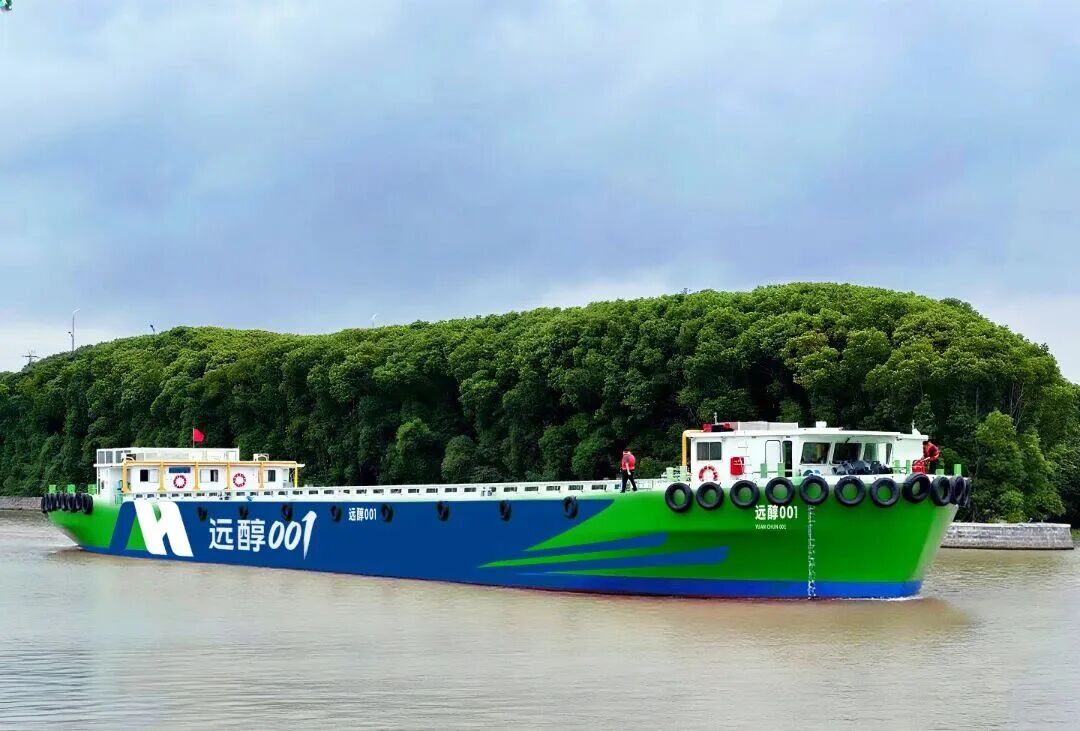
The initiative builds on an existing technological and operational precedent. In October 2025, the world's first methanol-electric multipurpose container and general cargo vessel, Yuanchun 001, powered by Geely Farizon's independently developed methanol-hydrogen electric system, entered commercial operation at the Port of Shanghai.
The 1,500-dwt vessel can carry up to 64 TEUs and has a range of nearly 1,500 kilometers on a single refueling, approximately four times that of a fully electric vessel of comparable tonnage. The successful commercial deployment of Yuanchun 001 provides real-world technical validation and operational experience for Yuanchun Shipping's planned large-scale rollout of methanol-powered vessels.
For Geely, Yuanchun Shipping represents a new and differentiated foothold in the shipping industry. Previously, its Jisu Logistics business operated a dedicated fleet of ro-ro vessels primarily serving the seaborne export of finished vehicles. In May 2025 and September 2026, the LNG dual-fuel ro-ro vessels Jisu Fortune and Jisu Glory, respectively, made their maiden voyages to Europe from Ningbo-Zhoushan Port.
Yuanchun Shipping, by contrast, is focused on methanol-powered cargo transportation on inland waterways, targeting the domestic market for the adoption of cleaner shipping alternatives. The move also creates a link between Geely's existing expertise in methanol-hydrogen electric technology and its expanding presence in the shipping sector.
Against the backdrop of Huzhou's emerging integrated ecosystem connecting cargo, ports, vessels and shore-side infrastructure, Yuanchun Shipping is expected to serve as a key operating platform. The pace of its fleet deployment and the performance of its demonstration routes will provide an important test case for the commercial viability of methanol-powered inland shipping in China.
Hot News