


One in every 10 containers has a defect!
Source:
2026-09-17
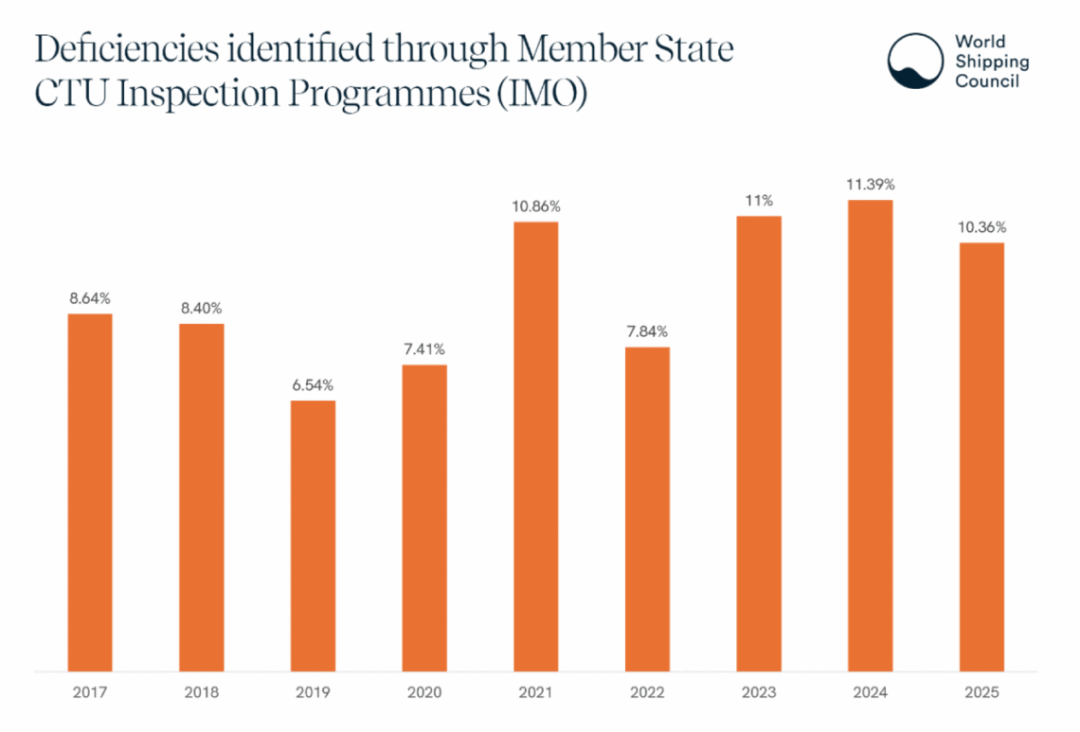
According to data compiled and published by the World Shipping Council (WSC), more than one in ten cargo transport units inspected in 2025 were found to have safety deficiencies, highlighting persistent risks related to cargo declaration, packing, marking and securing.
Joe Kramek, President and CEO of the World Shipping Council, said: “More than one in ten units inspected had deficiencies, and that rate is far too high. Proper declaration, packing, securing and marking are basic safety obligations. When these requirements are not met, people’s lives are put at risk.”

The inspection results showed that government authorities in seven countries reported 93,079 unit inspections, finding 9,645 units with deficiencies, a deficiency rate of 10.36%, compared with 11.39% in 2024. Problems included incorrect documentation, non-compliant marking and labeling, improper packing and inadequate cargo securing. The data summarize inspection results submitted to the International Maritime Organization (IMO) by Chile, Finland, Germany, the Kingdom of the Netherlands, the Republic of Korea, Sweden and the United States.
The WSC also cited the latest statistics from insurance giant Allianz, noting that a container ship fire occurs on average every 17 days.
Data analysis shows that between 2017 and 2025, the average deficiency rate exceeded 9%, but fell as low as 6.5% and 7.4% in 2020 and 2021. Over the past three years, the deficiency rate has trended upward, exceeding 11% in 2024, with a three-year average of 10.9%.
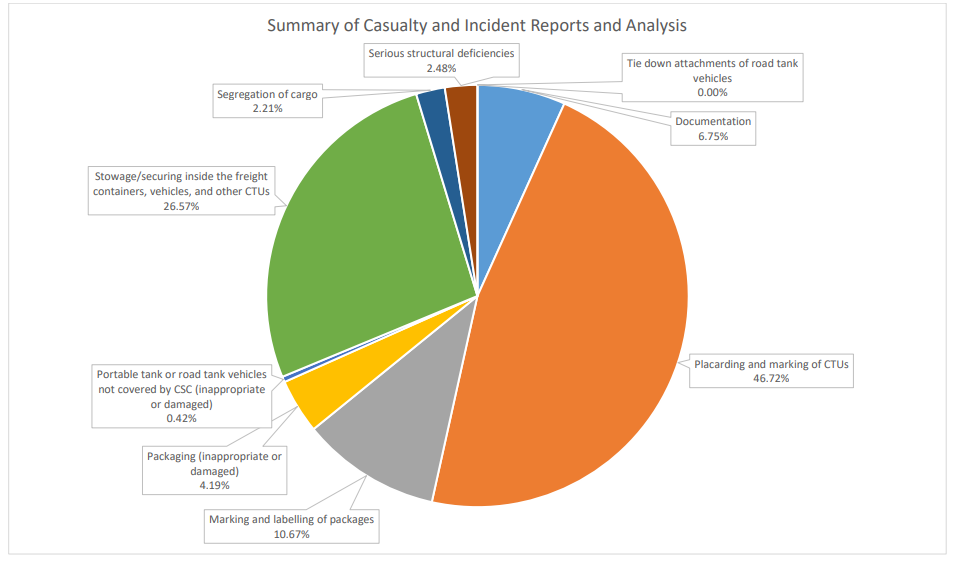
The breakdown shows that CTU signage and marking accounted for the largest share of identified deficiencies, at 46.72%, followed by stowage and securing inside containers, vehicles and other cargo transport units, at 26.57%. Packaging marking and labeling accounted for 10.67%, and documentation for 6.75%. Other deficiencies included improper or damaged packaging (4.19%), serious structural defects (2.48%), cargo segregation (2.21%), and portable tanks or road tankers not subject to the International Convention for Safe Containers (CSC) (0.42%). No deficiencies were recorded in the category of securing devices for road tankers.
After the IMO stopped publishing annual summary reports in 2024, the WSC took over the compilation and publication of these results, so that governments and the shipping industry can still access inspection data.
However, the WSC noted significant gaps in global reporting. Of the IMO’s more than 170 member states, only seven reported container inspection results for 2025, meaning the available data cannot fully reflect the state of global cargo safety compliance.
Last week, the WSC also highlighted gaps in international dangerous goods regulations and called on IMO member states to close them, noting that containers are currently carrying thousands of undeclared lithium batteries. The organization said that, according to data from the International Energy Agency, global lithium-ion battery deployments in 2025 were six times those in 2020, and battery demand is expected to double by 2030.
Hot News