


World's first multipurpose cargo ship fitted with 22-meter 'suction sail'!
Source:
2026-08-10
Spanish wind propulsion company Bound4blue has successfully installed a 22-meter-high eSAIL® suction sail on the new multipurpose vessel "Na Hiro E Pae".The ship, owned by the French Polynesian shipping company SNA Tuha’a Pae Shipping Company, is the world's first known multipurpose vessel equipped with wind-assisted propulsion, marking a critical step forward in the engineering application of wind-assisted power on complex hull types.
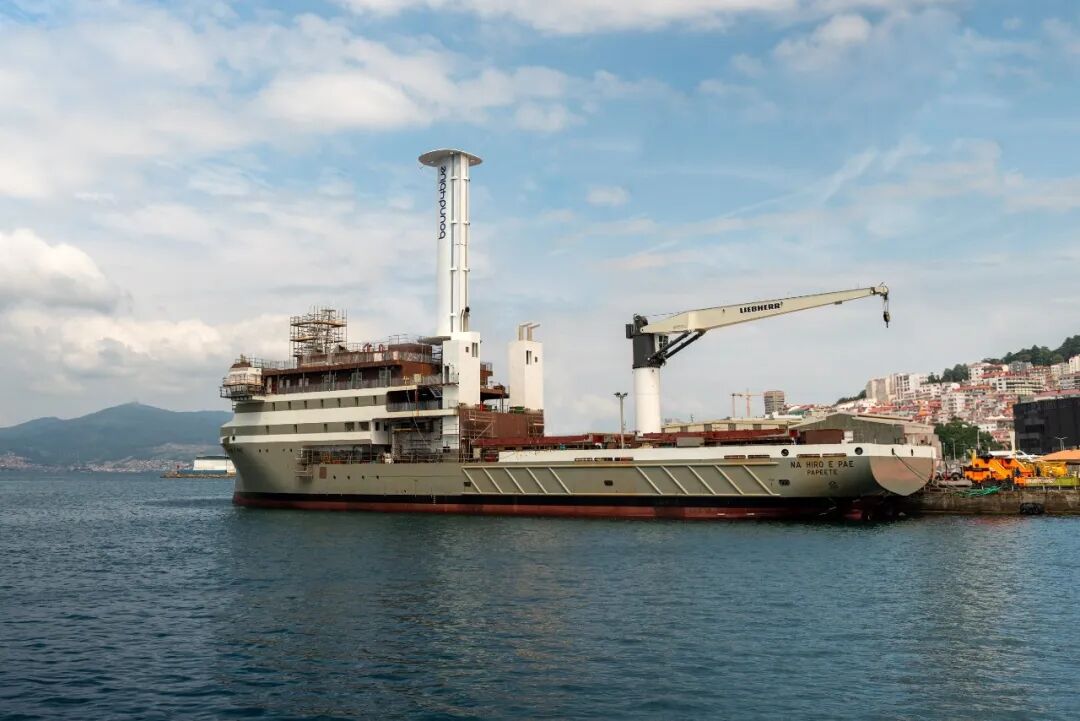
In French Polynesia, multipurpose cargo ships are often referred to as "goelettes", a name derived from the schooners that historically relied on sails to deliver supplies to remote islands. The "Na Hiro E Pae" revives the spirit of sailing with modern technology – the eSAIL® suction sail supplied by Bound4blue not only pays homage to local maritime culture but also upgrades traditional wind energy into an efficient, controllable auxiliary power solution.
Prior to delivery, the installation was completed at the Armon Vigo shipyard in Vigo, Spain. The "Na Hiro E Pae" is now operating on a regular route between Tahiti and the Austral Islands, transporting passengers, food and general cargo, providing an indispensable lifeline for remote communities. The vessel's design balances comfort and practicality: it can carry up to 200 passengers, while offering rapid loading and unloading capabilities and a single-voyage cargo capacity of up to 1,500 tonnes, effectively safeguarding the livelihoods and economic activity of the South Pacific islands.
Bound4blue's eSAIL® features a mechanically simple suction sail design that delivers up to seven times the propulsive force of a conventional rigid sail of the same size. The system is part of a "green technology package" that also includes engines capable of running on biofuels or e-fuels, electric pod propulsion, efficient waste management and a self-sufficient freshwater system, significantly reducing the vessel's overall environmental footprint. According to estimates, a single eSAIL® can cut the ship's energy consumption by approximately 10%, while also helping to improve its Energy Efficiency Design Index (EEDI) and Carbon Intensity Indicator (CII) ratings. This installation represents not only the first application of a Wind Propulsion System (WPS) on a multipurpose vessel worldwide, but also the first deployment of this technology in French Polynesia – a dual breakthrough.
José Miguel Bermúdez, CEO and co-founder of Bound4blue, said: "Multipurpose ships have traditionally been considered a difficult segment for wind propulsion, due to their operational flexibility and high integration requirements. But this project proves that with close collaboration between the system supplier, naval architects, the shipowner and all stakeholders, these challenges can be overcome. We are very pleased to share the spotlight with so many complementary technologies on board, offering the shipowner a tangible example of how to optimise both environmental and commercial performance. We hope the 'Na Hiro E Pae' will inspire more shipping companies to take the step towards sustainable transformation."
Boris Piel, Technical Director of the shipowner, emphasised: "Sustainability has been our core goal from the very beginning of the design process. The eSAIL® works in synergy with the rest of the vessel's technical solutions to reduce energy consumption and environmental impact, while maintaining the reliable transport service that communities depend on. This project demonstrates that innovation and practicality can go hand in hand, an we are proud to lead the adoption of wind propulsion on this vessel type."
The project was also supported by the French Polynesian government's "Call for Expressions of Interest" initiative, aimed at promoting fleet renewal, regional connectivity and improved environmental performance. As a leader in wind-assisted propulsion, Bound4blue has now installed eSAIL® systems on a cumulative total of 12 vessels, with a further 6 ships on order, representing over 50 suction sails in total. These autonomous, non-explosion-proof devices can effectively reduce main engine load, achieve double-digit percentage fuel savings, and significantly cut greenhouse gas emissions, delivering substantial regulatory compliance and economic benefits for shipowners.
Hot News