


Nearly Half of Container Ships’ Time in Port Spent “Idling”?
Source:
2026-11-03
According to the latest World Bank research, nearly half of container ships’ time in port is spent on activities other than cargo handling. The study points out that, compared with expensive infrastructure investment, improving management is more likely to unlock considerable terminal capacity.
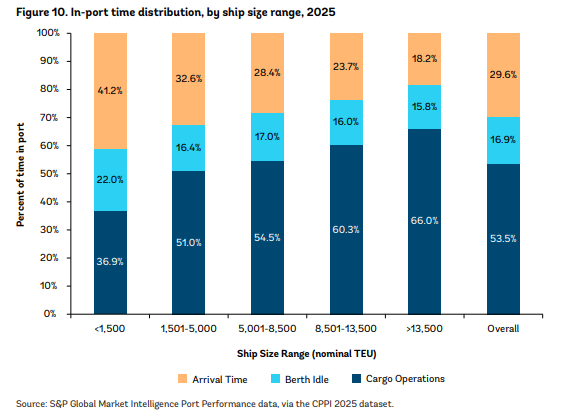
The World Bank’s Container Terminal Performance Improvement Guide, based on 2025 port call data from S&P Global Market Intelligence, found that cargo-handling operations account for only 53.5% of total port time, with the remaining 46.5% used for arrival, waiting, berth idle time, and departure processes. The report notes that some of these stages are unavoidable, but others still have room for improvement.
Data show that ships wait an average of 12.3 hours to berth, while arrival processes take a total of 16.4 hours; from berthing to the first container move takes an average of 2.1 hours, and from the last move to unmooring takes another 2.3 hours.
The report cautions that crane productivity should not be used as the sole measure of terminal efficiency. Bottlenecks in other areas—such as the yard, gates, equipment availability, and workforce deployment—may undermine improvements in seaside cargo-handling efficiency. The World Bank states that “binding constraints determine a terminal’s effective capacity” and urges operators to identify the weakest links before making additional infrastructure investments.
The report also warns that maximizing berth occupancy should preferably not be pursued. Citing Drewry data, the study says the average capacity utilization rate of global container terminals was 72.2% in 2025 and is expected to rise to 73.1% by 2030. Congestion risk increases after utilization exceeds 70% and rises sharply above 80%, although the actionable threshold varies by terminal.
In terms of improvement measures, the report recommends more dynamic berth scheduling, stronger coordination with liner companies, preventive maintenance, flexible staffing, and shared cargo-handling equipment pools. The guide notes that shared equipment pools can deliver productivity gains of 10% to 20%.
As for automation, the report does not regard it as a universal solution. The World Bank believes that new systems should target already identified operational weaknesses, rather than becoming projects that involve “an expensive upgrade first and a search for problems afterward.”
Hot News