


The Trans-Pacific route has become the golden trade lane of liner shipping
Source:Beyond Shipping
2026-11-06
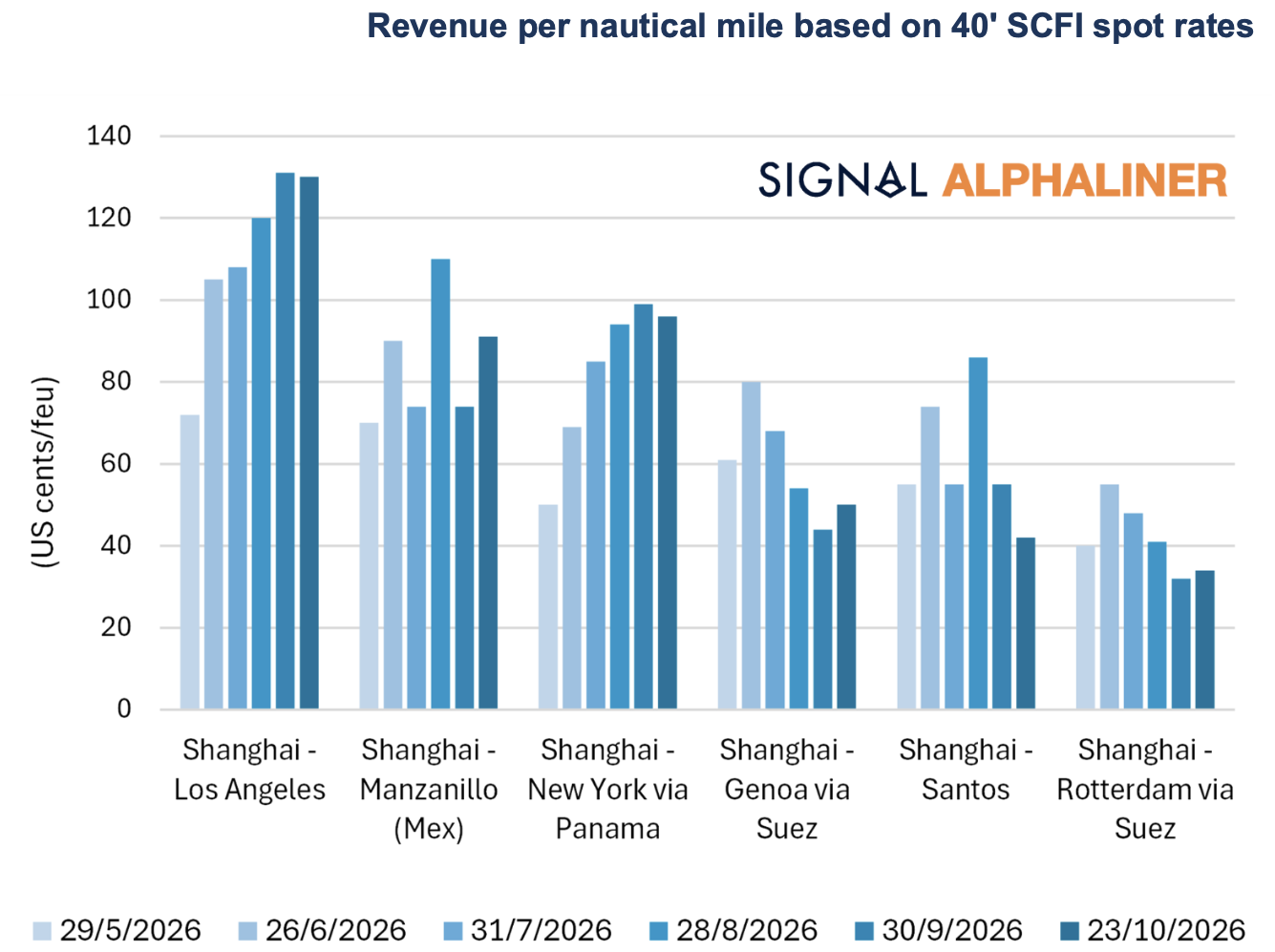
The Trans-Pacific route has become the most profitable major container trade lane in the world. On the Shanghai–Los Angeles route, shipping companies earn five times as much spot freight revenue per nautical mile as on the route to North Europe via the Cape of Good Hope.
Alphaliner’s latest analysis shows that the strong performance of the US trade market has far exceeded the traditional peak-season cycle, with freight rates approaching pandemic-era highs.
The Shanghai–Los Angeles route covers 5,775 nautical miles, with spot freight at about USD 7,500 per 40-foot equivalent unit (FEU), equivalent to USD 1.30 in revenue per FEU per nautical mile.
By comparison, Shanghai–Rotterdam via the Cape of Good Hope is only USD 0.26 per FEU-nautical mile; via the Suez Canal to Rotterdam, USD 0.34 per FEU-nautical mile; and Shanghai–New York, USD 0.96 per FEU-nautical mile, with spot rates on that route having remained above USD 10,000/FEU since late August.
Major shipping lines are deploying more capacity to the Trans-Pacific. Mediterranean Shipping Company (MSC) recently upgraded its “Sentosa” service, replacing vessels of about 15,000 TEU with 23,600-TEU ultra-large container ships. ZIM currently has 52% of its capacity deployed in the Pacific market and will launch a new China–California service in December.
The booming market has directly boosted corporate results. COSCO Shipping reported third-quarter liner business profit of USD 2.66 billion, doubling year on year, with revenue on Trans-Pacific routes surging 61.2%.
Freightos data confirm that the strong momentum on the Trans-Pacific route has continued into November. In its latest assessment, Asia–US West Coast rates stood at USD 8,340/FEU, and Asia–US East Coast rates at USD 9,911/FEU.
Freightos said current rates remain about USD 5,500/FEU higher than before the peak season; the upcoming Lunar New Year stocking cycle may curb the extent of any rate correction.
However, the market has already shown signs of cooling. A Drewry report shows that last week Shanghai–Los Angeles rates fell 6% to USD 7,514, while Shanghai–New York fell 5% to USD 9,631. The consultancy forecasts that US ocean imports will decline 11% month on month in November, and freight rates may weaken further.
Meanwhile, Sea-Intelligence said Trans-Pacific capacity deployment has reached an unprecedented scale. Weekly Asia–US West Coast capacity is expected to reach 400,000 TEU in November, although port congestion and late vessel departures are also inflating this statistic.
Hot News