


The Global Liner Network Is Entering an Era of Fewer Port Calls
Source:CNSS
2026-07-14
According to the latest analysis from Sea-Intelligence, the global liner shipping industry has entered a new operational model characterised by a significant reduction in port calls while maintaining a broad direct trade network.
The report shows that while carriers have largely preserved the geographical breadth of their network coverage since the pandemic-induced disruptions of 2020, service frequency has declined notably, resulting in a structurally leaner global network.
Sea-Intelligence data reveals that the number of global deep-sea direct port pairs rose from 6,553 in January 2012 to a peak of 12,056 in 2018, while monthly port calls similarly climbed from 42,129 to 81,926 over the same period. However, this long-standing correlation was broken in 2020.
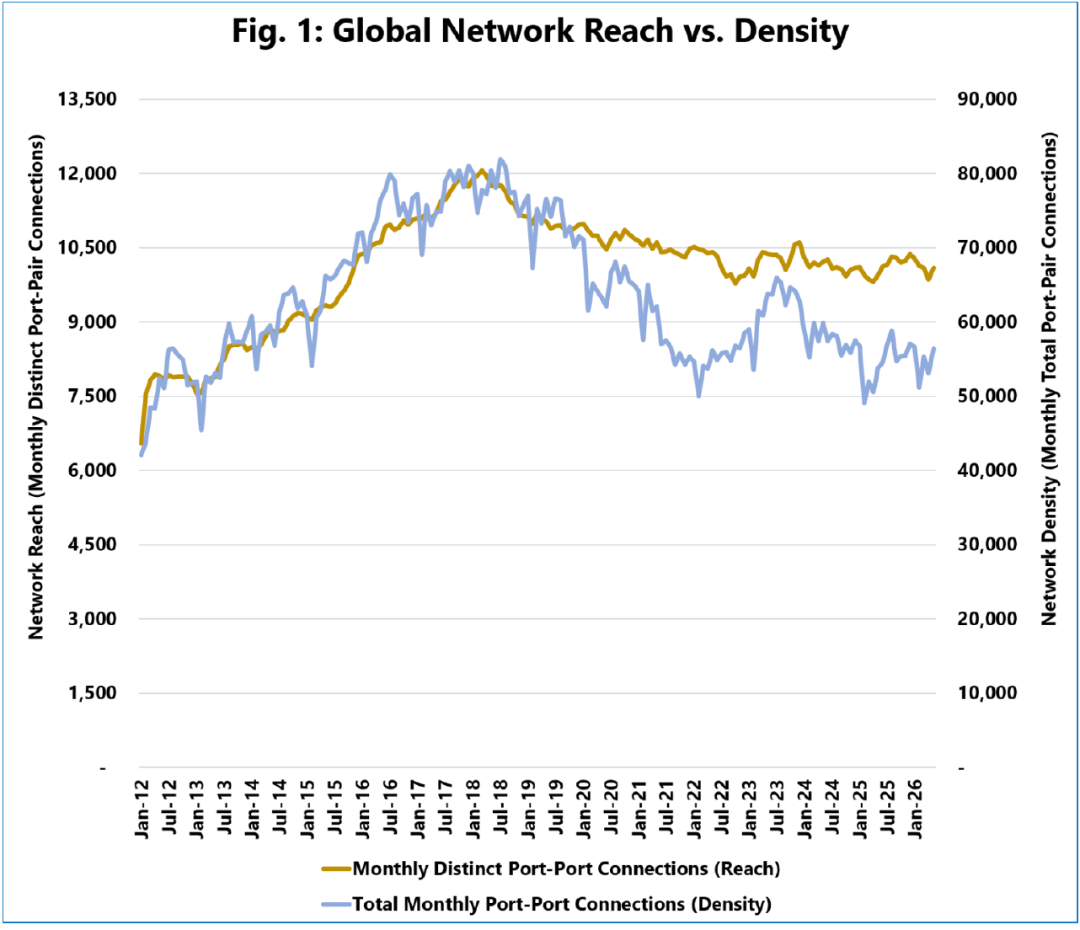
Since then, network coverage—measured by the number of direct port pairs—has stabilised at around 9,800 to 10,400 pairs, while network density, expressed as total monthly port calls, has fallen back to a lower range, oscillating between 53,000 and 65,000 calls.
Alan Murphy, CEO of Sea-Intelligence, stated: "The liner shipping industry appears to have established a leaner operational baseline, choosing to maintain relatively broad network coverage while reducing direct call frequency and shifting more cargo volumes toward transshipment."
The findings suggest that carriers are prioritising network reach while relying more heavily on transshipment hubs to maintain global connectivity. This reflects a structural shift in liner service network design rather than a temporary response to market disruptions.
Hot News