


Stranded Bulker with 40,000 Tons of Iron Ore at Risk of Sinking
Source:
2026-11-24
A dilapidated bulk carrier fully laden with iron ore has been stranded in the lagoon of Majuro Atoll for nearly a year. According to a report submitted to the government of the Marshall Islands, the vessel's condition continues to deteriorate, and it could sink at any moment without warning.
The vessel is named Futun Creek (formerly Spar Orion). Built in 1996 and sailing under the Marshall Islands flag, she has a deadweight tonnage of 47,639 DWT, a length of approximately 190 meters, and a beam of about 30.5 meters. Equasis data shows that the shipowner is Ocean Link Shipping, and the ship manager is Lian Yang Shipping.
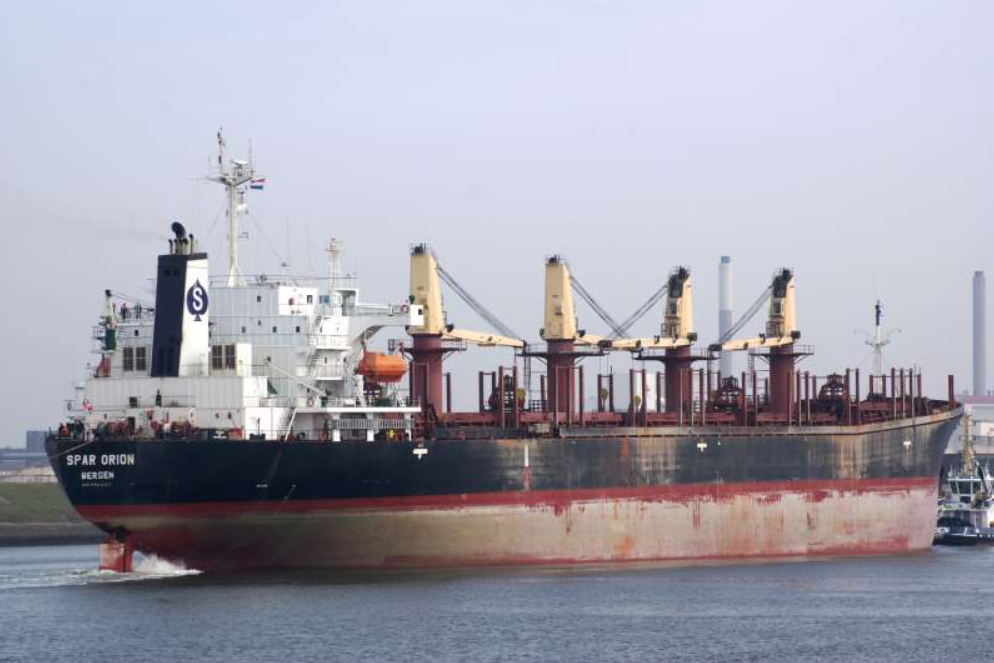
In January of this year, while en route from South America to China, the vessel sustained multiple hull breaches. In poor condition, she barely managed to reach Majuro Atoll, home to the capital of the Marshall Islands, where she has remained anchored in the port ever since. An assessment by the U.S. Coast Guard (USCG) indicated that, in her current state, the ship is no longer seaworthy and is highly unlikely to stay afloat for much longer.
Although the hull was patched following her arrival, the vessel has never departed Majuro, and her structural condition has continued to worsen.
The report notes that a sinking would pose a severe threat to the marine ecological environment of Majuro Atoll. Furthermore, with approximately 30 crew members from various nations still on board, the incident also involves humanitarian concerns and may present challenges under international law.
According to a report released by the Republic of the Marshall Islands (RMI), the assessment of the Futun Creek revealed severe structural aging, including extensive corrosion and structural damage in one cargo hold, fractured and deformed hull framing, and multiple severe cracks and hull breaches. Investigators also discovered that the vessel is currently taking on water in at least one location.
Quoting the USCG assessment, the report summary stated that continuous water ingress could further compromise the vessel's stability and structural integrity, potentially leading to structural failure and even capsizing without warning. The report emphasized that the vessel's deteriorating condition in the lagoon exacerbates local environmental risks and maritime safety hazards.
Scuttling the vessel in place is currently one of the disposal options under consideration. However, the Marshall Islands government must also weigh numerous factors, including ship ownership, the flag state (Panama), insurance companies, the costs of potential salvage operations, and the repatriation of the crew.
The Marshall Islands Journal reported in its October 2, 2026, issue: "At current market prices, the 40,000 tons of iron ore on board is valued at approximately $4 million. However, after the vessel has been berthed in Majuro for nine months, the cargo remains undelivered, suggesting that the cargo owners either lack the intention to claim it or have no means to complete the delivery."
Similar long-term strandings are not without precedent.
On September 19, 2022, the Panama-flagged bulk carrier BLUEWAYS ran aground and flooded near Chengshan Town in Rongcheng, Weihai, Shandong Province, due to the outer circulation of Typhoon "Nanmadol" and cold air influences. All 25 crew members were rescued. The ship had originally planned to head to a local port for upgrades and refits, but following the grounding, high de-floating and towing costs prevented its removal.
In 2023, local authorities stated that the shipowner had completed anti-pollution measures, the vessel had been powered down, and fuel tanks had been emptied, with no impact on local water quality or navigational safety at the time. In August 2024, local personnel confirmed to the media that the vessel had been transferred to a local enterprise and would not be towed away in the short term. Subsequently, the stranded bulk carrier became a popular local tourist attraction.
In June 2000, an ore carrier named River Princess (114,645 DWT) dragged her anchors in severe weather and ran aground near Sinquerim Beach in Goa, India. Following the incident, the vessel remained stranded near the coast for a long period. Despite multiple efforts by local authorities to push for removal, delays in salvage plans, contracts, and subsequent disposal meant the ship was not promptly removed.
Large-scale clearance operations finally began in 2011 and were largely completed by 2012. The vessel's presence on the coast for approximately 12 years not only marred the coastal landscape but also caused coastal erosion and environmental issues, with final clearance costs reaching about 990 million Indian rupees (approx. $10.66 million).
Another retired bulk carrier, MV Miner (27,650 DWT), was stranded in Canada for nearly four years. In September 2011, while being towed to Turkey for scrapping, she encountered severe weather, her towline parted, and she ultimately ran aground near Scatarie Island, Nova Scotia. Due to safety risks associated with salvage and repeated delays in disposal plans, the wreckage was not completely cleared until June 2015.
During the clearance process, workers discovered approximately 32 tons of asbestos and over 26,000 liters of diesel left on board, increasing the difficulty of dismantling and the potential environmental risks. The final contract for this clearance project amounted to 11.9 million Canadian dollars (approx. $8.31 million).
The risks of a ship grounding do not end with the evacuation of the crew. Especially when hull structures continue to deteriorate and fuel oil or other hazardous substances remain uncleared, long-term stranding can further increase the difficulty of environmental cleanup, hull fragmentation, and wreck removal.
Hot News