


40 New VLCCs: World’s Largest Oil Tanker Owner Expands Fleet
Source:
2026-11-11
As the global tanker market enters a new upcycle, COSCO Shipping Energy is accelerating the expansion of its large crude carrier fleet.
On November 9, COSCO Shipping Energy announced that its wholly owned subsidiary, Hainan COSCO Shipping Energy Transportation Co., Ltd. (“Hainan Energy”), will invest in the construction of 10 VLCC crude oil tankers. At the same time, another wholly owned subsidiary, Huanyu Shipowners Enterprise Co., Ltd. (“Huanyu Shipowners”), plans to introduce 14 new VLCCs through long-term bareboat charters.
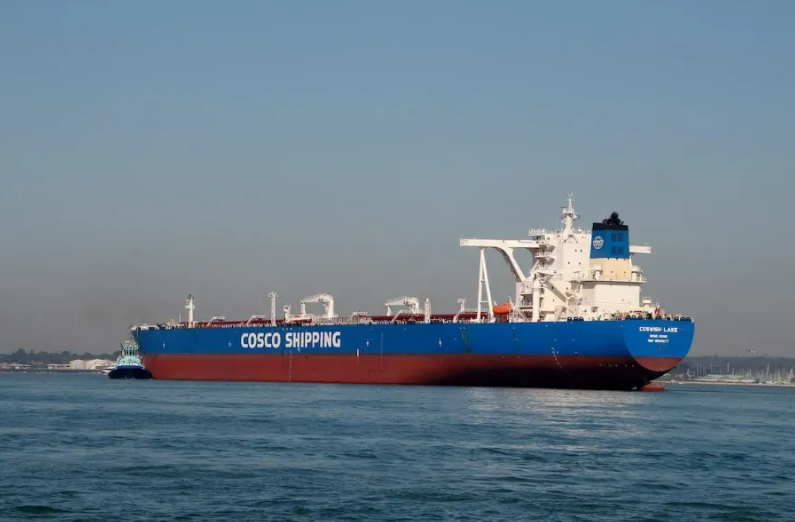
This means COSCO Shipping Energy has now disclosed specific construction and charter arrangements for 24 new VLCCs, comprising 10 self-financed newbuildings and 14 long-term bareboat charters. The vessels are expected to be delivered between 2029 and 2030.
In addition to these 24 vessels, the company’s board of directors has also approved another project involving the long-term charter of 16 new VLCCs through a finance-industry cooperation arrangement.
10 VLCCs to be built at two shipyards
According to the announcement, the 10 new VLCCs will be built by Yangzhou COSCO Shipping Heavy Industry Co., Ltd. (“Yangzhou Heavy Industry”) and Dalian Shipbuilding Industry Co., Ltd. (“DSIC”).
Hainan Energy has signed contracts with Yangzhou Heavy Industry for six VLCCs at a contract price of RMB 948 million per vessel, bringing the total contract value to about RMB 5.689 billion. Including capitalized costs such as interest during construction and supervision fees, the total investment is approximately RMB 5.743 billion. Delivery is planned between August 2029 and November 2030.
The remaining four VLCCs will be built by DSIC at the same contract price of RMB 948 million per vessel. The total contract value is about RMB 3.793 billion, and the total investment after including related capitalized costs is approximately RMB 3.829 billion. These vessels are expected to be delivered between September 2029 and May 2030.
Based on these figures, the total contract price for the 10 VLCCs is approximately RMB 9.482 billion, with total investment of about RMB 9.572 billion.
Both batches of newbuildings take future fuel transition into account. The six VLCCs built by Yangzhou Heavy Industry will adopt LNG-fuel-ready clean power systems, while the four vessels built by DSIC will use LNG/methanol dual-fuel-ready solutions. The ships will also be equipped with energy-saving and intelligent systems.
Six financial leasing companies involved
In addition to self-financed construction of 10 VLCCs, COSCO Shipping Energy plans to further expand its fleet through long-term bareboat charters.
Huanyu Shipowners intends to bareboat charter 14 new VLCCs from six financial leasing companies — BOCOM Financial Leasing, ICBC Financial Leasing, ABC Financial Leasing, BOC Financial Leasing, CITIC Financial Leasing and Minsheng Financial Leasing. The charter period will not exceed 20 years from the date of delivery.
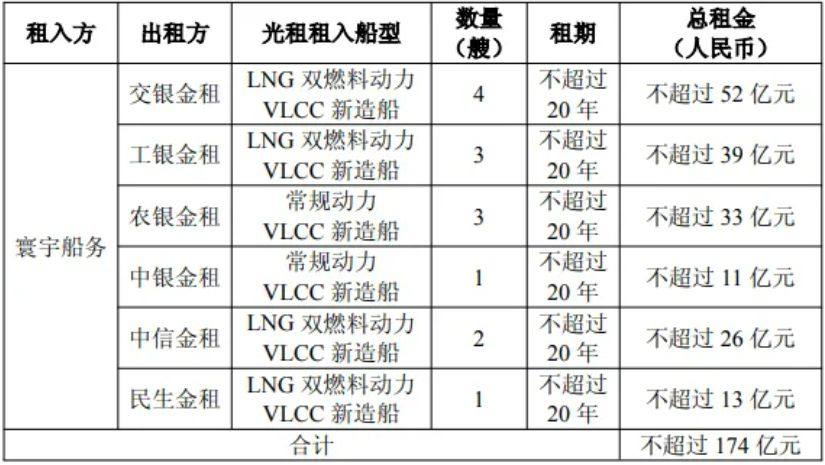
Under the proposed arrangement, total charter hire for the 14 vessels over the charter period will not exceed RMB 17.4 billion, with fixed charter hire rates. The vessels are expected to be delivered during 2030.
COSCO Shipping Energy said that supplementing VLCC capacity through long-term bareboat charters can reduce overall financing costs and upfront capital outlays, while expanding medium- to long-term fleet size and strengthening its service capability and market share in the international crude oil transportation market.
No further details have been disclosed regarding the lessors, shipyards, charter periods, hire rates or delivery schedules for the 16 long-term chartered VLCCs.
If this project proceeds smoothly, COSCO Shipping Energy’s planned intake of new VLCCs will increase further. However, until specific agreements are signed, these 16 vessels should not be combined with the 24 VLCCs for which transaction arrangements have already been disclosed.
Wall Street raises VLCC freight forecasts but warns market may be near peak
COSCO Shipping Energy’s large-scale VLCC expansion comes as the global tanker market experiences unusually strong conditions. However, investment banks are increasingly divided over how long the current upcycle can last.
Evercore ISI recently raised its VLCC earnings forecasts significantly. Analyst Jonathan Chappell lifted the 2027 VLCC daily earnings forecast from $57,500 to $115,000, nearly doubling it, while the 2026 forecast was raised by 97 percent to $215,000 per day.
Evercore expects VLCC spot daily earnings in the fourth quarter of 2026 could reach $476,000. However, the bank believes VLCC earnings may gradually decline in 2027 after a short-term spike.
In Chappell’s view, the current abnormal earnings in the tanker market are not entirely driven by traditional supply-demand fundamentals, but are largely influenced by ongoing geopolitical disruptions in the Middle East.
Another investment bank, Jefferies, believes that tanker earnings may fall more slowly than investors expect. It forecasts average VLCC daily earnings of $65,000 in 2027, supported by fleet aging and potential large-scale crude oil inventory replenishment demand.
Newbuilding delivery pressure is building
Beyond differing views among investors, shipbrokers have also begun to focus on changes in the tanker market.
Braemar pointed out that excessively high shipping costs are affecting Asian refiners’ crude purchasing choices. Some refiners are beginning to prefer Middle Eastern crude with shorter transport distances rather than crude from the Atlantic Basin. This shift could weaken long-distance crude transportation demand and put pressure on VLCC tonne-mile requirements.
Evercore also issued a warning on the global crude demand outlook. Its compiled global crude demand growth forecasts for this year have turned negative, with full-year demand expected to fall by 1.75 million barrels per day. Evercore noted that annual declines in global crude demand have occurred only in 2009 and 2020 over the past 30 years, and both periods were followed by very difficult conditions in the tanker market.
At the same time, growth in new tanker supply is becoming another issue that cannot be ignored.
Based on Clarksons data, Evercore expects global tanker newbuilding deliveries to reach 50.1 million DWT in 2027, rise further to 62.8 million DWT in 2028, a record high, and remain at 54.9 million DWT in planned deliveries for 2029.
The bank estimates that, before accounting for运力 efficiency losses caused by geopolitical disruptions, the global tanker fleet will grow by 5.3 percent this year and by 5.5 percent in 2027.

Supply pressure in the VLCC market is particularly pronounced. Hartland Shipping Services expects annual VLCC deliveries in 2028 and 2029 to exceed 100 vessels, a level rarely seen since the super-tanker boom of the 1970s. According to BRS, the VLCC orderbook already includes 283 vessels scheduled for delivery in 2028 and beyond.
In sharp contrast to the rising number of new orders, old tanker scrapping remains weak. Data from Banchero Costa shows that only four VLCCs were scrapped worldwide in the first nine months of 2026.
Delivery timing tests owners’ judgment on the market cycle
For COSCO Shipping Energy, the planned addition of 24 VLCCs will further expand its large crude transportation capacity. However, in terms of timing, the 10 self-built VLCCs will mainly be delivered between 2029 and 2030, while the 14 bareboat-chartered VLCCs are also expected to enter service during 2030. This means that when these new vessels actually reach the market, the global VLCC fleet may already be facing a wave of concentrated deliveries.
For shipowners, while current high freight earnings are attractive, judging the supply-demand balance several years ahead and controlling newbuilding investment risks may be more important than capturing the current freight rate upswing.
Hot News