


197 VLCCs Ordered in First Half of 2026: Newbuilding Market Shatters Records Dating Back Nearly 60 Years
Source:
2026-07-16
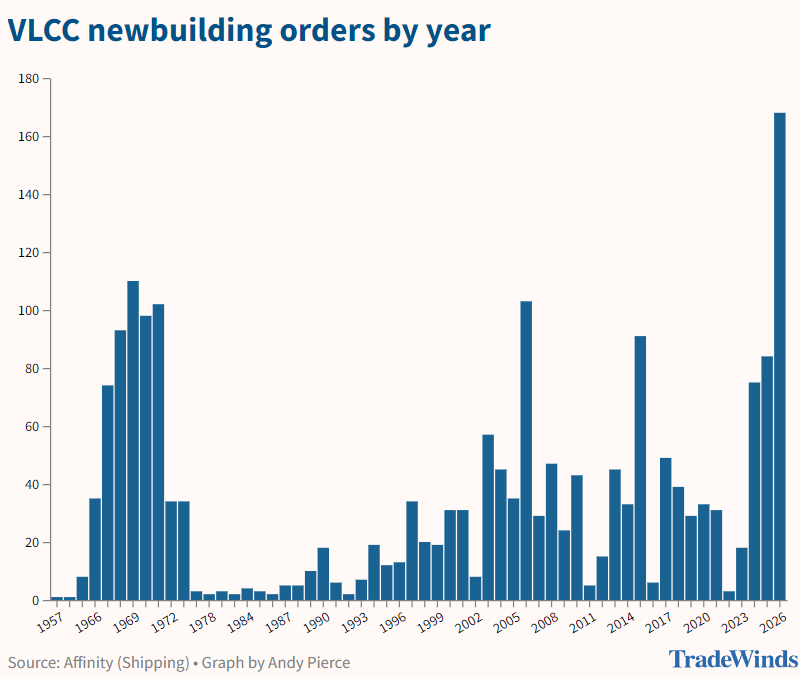
The first half of 2026 has witnessed an unprecedented surge in newbuilding orders for Very Large Crude Carriers, with the total volume contracted not only surpassing the peak of the previous super-cycle but also breaking all historical records dating back to the late 1960s.
Data from multiple shipbroking firms and shipping analytics houses confirm that global VLCC newbuilding orders grew exponentially between January and June this year. Veson Nautical, a leading maritime data provider, reports that first-half orders surged nearly tenfold year-on-year, with analyst Rebecca Galanopoulos noting: "197 VLCCs have been ordered in the first half of 2026, compared with just 24 in the same period last year."
Affinity's records corroborate this explosive trend—168 new VLCCs contracted year-to-date, comfortably exceeding the previous all-time high of 110 vessels set in 1969. According to the firm's historical data, only two other years—1971 (102 vessels) and 2006 (103 vessels)—had ever seen contracting exceed 100 vessels, a level that 2026 has now surpassed within just six months.
Chinese shipbuilders have been particularly prominent in this ordering spree. According to broking data, Hengli Heavy Industry holds a commanding lead with 86 orders, followed by Dalian Shipbuilding Industry with 18, while Hanwha Ocean ranks third with 16. Filipe Gouveia, Shipping Analysis Manager at BIMCO, notes that 2026 has already become the highest year on record for crude tanker newbuilding contracting. Data from chartering platform Signal Ocean shows that VLCC orders alone accounted for 78% of the global tanker orderbook during the first half.
Analysts attribute this VLCC ordering wave to a confluence of factors. First and foremost is the immense pressure for fleet renewal. The ageing of the global VLCC fleet has become increasingly acute, with the average age having risen steadily since 2011 to reach 14 years today. Lauren Gallinari, an analyst at global shipbroking and maritime consultancy MJLF & Associates, notes that of the 926 VLCCs currently in service, 205 vessels—approximately 22%—are aged over 20 years, with this elderly tonnage urgently requiring replacement.
Geopolitical risk represents another significant catalyst. The sustained tensions in the Strait of Hormuz are markedly shaping market expectations. The current crisis is expected to compel major oil-importing nations to substantially boost their strategic petroleum reserves, implying that oil demand will far exceed actual consumption levels for several years to come—a structural tailwind for VLCC transportation. Ms. Gallinari believes that owners' willingness to commit substantial capital at historically elevated newbuilding prices is not born of blind optimism, but rather reflects an assessment of the long-term evolution of the geopolitical landscape. Additionally, robust earnings and charter rates have provided solid underpinning for the order surge—one-year time charter rates remain elevated on a year-on-year basis, while charterers' willingness to commit to forward delivery dates has further bolstered owners' ordering confidence.
The exuberance in the newbuilding market has also spilled over into the second-hand sector. A total of 127 VLCC second-hand transactions were recorded in the first six months of 2026, compared with just 85 for the entirety of 2025. Roughly half of these deals were concentrated early in the year by South Korean owner Sinokor, backed by the Aponte family behind Mediterranean Shipping Company. With newbuilding delivery lead times having stretched to three to four years, second-hand tonnage is increasingly favoured, driving prices higher. Signal Ocean data shows that a five-year-old VLCC is currently valued at US$174.5 million—significantly above the newbuilding price of US$129.8 million, illustrating the market's willingness to pay a premium for prompt capacity.
Despite the already substantial volume of new orders, analysts broadly concur that the market is capable of absorbing this new capacity, given that approximately a quarter of the global VLCC fleet is aged over 20 years, and that there is little cause for near-term concern about overcapacity. Looking ahead to the second half, several analysts expect the momentum in VLCC newbuilding orders to persist, though the pace of ordering may moderate relative to the exceptional levels seen in the first half. Ms. Galanopoulos summarised that, on balance, the underlying drivers behind the current cycle are expected to remain in place, even if the pace of ordering eases from the extreme levels witnessed during the first half.
Hot News