


China and Panama renew maritime port agreement – Foreign Ministry responds
Source:
2026-07-23
A reporter asked: According to Panamanian sources, China and Panama have reached a consensus on renewing a maritime transport agreement. Could you share more details? Additionally, are there any new developments regarding the detention of Panamanian-flagged vessels at Chinese ports?
Lin Jian responded: Regarding your specific questions, I would refer you to the competent Chinese authorities. What I would like to stress here is that China always develops its relations with Panama on the basis of equality, mutual benefit, and win-win cooperation. Strengthening exchanges and cooperation in various fields between China and Panama serves the interests of both countries and meets the common expectations of our peoples. After the establishment of diplomatic ties, the two countries signed a maritime transport agreement in 2018, granting Panamanian vessels most-favored-nation treatment at Chinese ports, as well as tariff preferences and customs clearance facilitation for ships flying the Panamanian flag. The above-mentioned maritime agreement is set to expire this year. Previously, after Panama canceled the concession rights of the Yangtze and Hutchison Group’s subsidiary, Panama Ports Company, for two ports on the Panama Canal, Panamanian side complained that its vessels were facing stricter inspections in China.
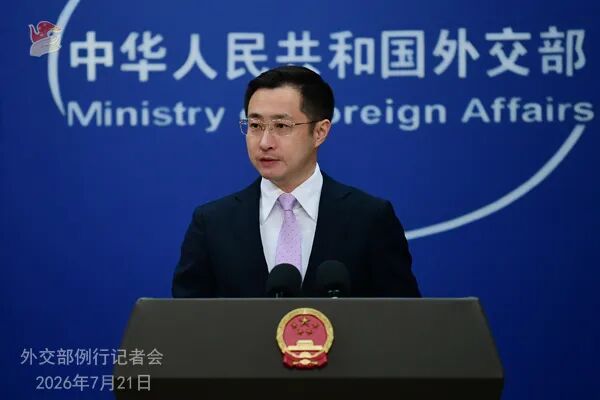
Looking back to the regular press conference on July 13, Spokesperson Lin Jian had already given a clear response regarding the inspection of Panamanian-flagged vessels in China. A reporter asked: It is reported that at the 137th session of the International Maritime Organization (IMO) Council, representatives of the United States and Panama condemned China for taking punitive measures against Panamanian-flagged vessels for political reasons, and called on the IMO to improve protection mechanisms to avoid politicizing maritime trade. What is China’s comment on this?
Lin Jian responded: According to statistics from China’s competent authorities, since the beginning of this year, Panamanian-flagged vessels have been involved in multiple serious accidents of Level 1 and above in Chinese waters, making Panama the flag state with the highest proportion of such accidents. From January to July this year, Panamanian-flagged vessels accounted for nearly 20% of the total foreign-flagged vessel calls at Chinese ports, yet they accounted for about 50% of the total vessel accidents and the number of deaths and missing persons. As an important measure to ensure navigation safety and protect the maritime environment, port State control (PSC) inspections are a primary means for all countries to exercise safety management over foreign-flagged vessels calling at their ports. China attaches great importance to waterway transport and personal safety, and carries out PSC inspections on vessels calling at Chinese ports in strict accordance with laws and regulations and in full compliance with international conventions.
Last month, China’s Ambassador to the United States and Permanent Observer to the Organization of American States (OAS), Xie Feng, attended the dialogue between OAS member states and observer states in Panama. When Panamanian leaders made unfounded accusations at the annual conference’s opening ceremony against China’s PSC inspections of arriving vessels, Ambassador Xie immediately clarified the facts. Xie Feng stressed that as a major shipping nation, China has always attached great importance to maritime transport and the safety of life. However, since 2026, Panamanian-flagged vessels have been involved in multiple collisions with fishing vessels in Chinese waters, resulting in multiple deaths and missing persons. Out of a sense of responsibility for shipping safety, including the safety of vessels and especially personnel, China carries out PSC inspections on arriving vessels in accordance with Chinese law and international conventions. These inspections are not targeted at any specific country or flag and are beyond reproach. Xie Feng also asked: In January this year, Panama’s Supreme Court suddenly issued a ruling to forcibly confiscate, take over, and expel a Chinese enterprise. Anyone with discerning eyes can see that this was politically orchestrated. If contracts can be torn up at will, market rules can be disregarded at will, assets can be taken over at will, and operators can be expelled at will, who would still come to invest and cooperate?
Hot News