


A control-transfer failure caused a ferry to strike a pier, injuring two people!
Source:
2026-09-28
A recent report released by the Transportation Safety Board of Canada (TSB) shows that in October 2024, a Quebec ferry struck a pier after a failure to transfer engine control between bridge stations, injuring five people. Investigators also found that after replacing the vessel’s engines and control system, the owner had not adequately addressed the associated risks.
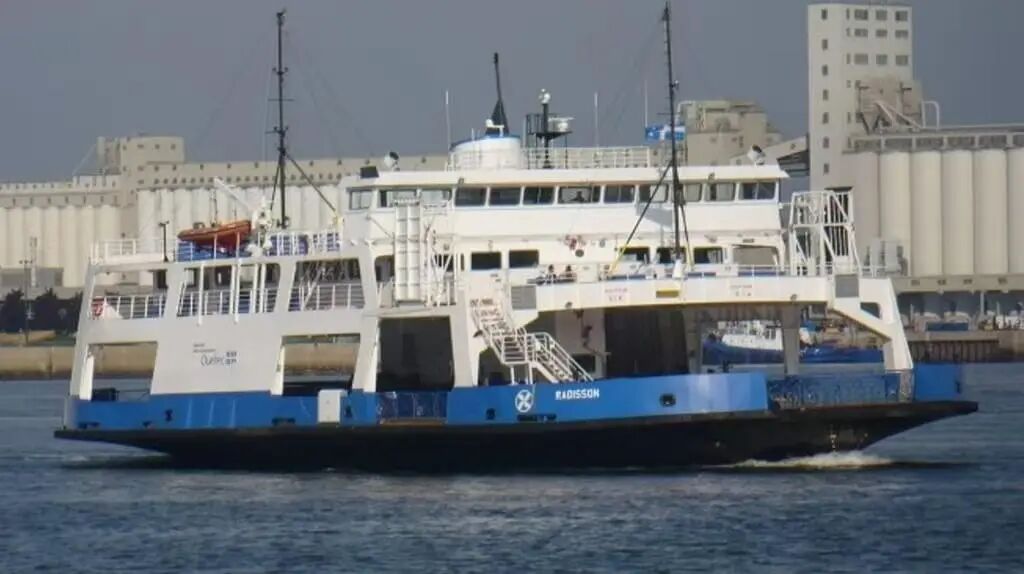
The Radisson is a 1954-built roll-on/roll-off passenger ferry with a gross tonnage of 1,062. It operates each spring and fall as a relief vessel on the Québec–Lévis route. On October 18, 2024, carrying 94 passengers and 9 crew members, it struck Pier 92 in the Port of Québec. The accident injured four passengers and one crew member. The ferry sustained minor damage to its bow, and several vehicles on the vehicle deck were damaged when they collided with one another due to the impact. There was no pollution.
In the fall of 2022, the Radisson’s original engines were replaced together with the bridge control system. In the old system, the control levers at three bridge stations were connected by chains and operated in tandem. The new electronic system did not have this linkage: for one station to take control, the operator had to adjust its propulsion lever to approximately match the position of the lever at the station handing over control. The owner, Quebec Ferry Company (STQ), wrote a new transfer procedure for this purpose, but TSB found that the procedure did not provide the crew with enough information to complete the transfer or confirm whether it had been successful.
On the night of the accident, the Radisson completed loading at Lévis at about 17:18 and headed for Pier 92 on the Québec side, a crossing that normally takes only about eight minutes. About a minute after departure, the captain began transferring control from the starboard station to the port station because the ferry would berth port-side. He then walked across the bridge to the port station.
Just after 17:22, as the ferry approached the berth at about 10 knots, the engines did not respond when the captain operated the port lever. At that point, the junction of Piers 91 and 92 was about 250 meters from the bow. The bridge team tried to take control from the other two stations, but both attempts failed. Because a vessel was moored at Pier 91, directly in the Radisson’s path, the captain turned to port to avoid it. Seconds before 17:24, the ferry struck the junction of the two piers at 6.3 knots. One passenger fell from a stairway and was seriously injured; the chief engineer was thrown backward against a switchboard and was injured. Several other passengers were thrown onto the deck by the force of the impact but were not injured.
After the new engines were installed on the Radisson, STQ conducted a risk assessment and rated several hazards as high risk, including the risk of collision during berthing and unberthing and failure of critical onboard equipment. Its proposed mitigation was to train bridge crew on the new control system. However, investigators found no records of specialized training on the new system, and the crew’s routine familiarization training did not cover how to transfer control. This lack of preparation made it harder for the bridge team to realize that the transfer had not been successful. In addition, after multiple transfer failures aboard the Radisson in spring 2024, crew members had proposed improvements to STQ; one of those failures also ended in a pier strike. These suggestions included providing clearer operating instructions and adding a third person on the bridge. However, none of these suggestions had been adopted by the time of the accident.
TSB found that once the captain initiated the transfer process, it was difficult to tell whether the transfer had been completed: the indicator lights were small and hard to see in daylight, and there was no audible alert. The captain did not learn that the transfer had failed until he tried to slow down during the final berthing phase, by which time there was not enough space to stop the vessel.
TSB also found that the crew was inadequately prepared to handle passengers in an emergency. Before the collision, no general alarm or public-address warning was sounded.
After the accident, STQ posted transfer procedures at each control station, rearranged the port station’s panel to align it with the other two stations, and installed an alarm that sounds continuously while a transfer is in progress. STQ also temporarily assigned a third crew member to the bridge. However, according to the report, even with these measures in place, in November 2025 the Radisson again struck a pier after another failure to transfer engine control.
Hot News