





Major Carriers Back Maritime Decarbonization as Fuel Market Evolves
Source:CNSS
2026-05-07
The 3rd Conference on Maritime Decarbonization and Green Marine Fuels will be held in Hangzhou on May 19, 2026. The conference will explore global shipping industry decarbonization trends and green fuel demand, international standards and certifications for green fuels, production processes for marine green methanol, green ammonia, green hydrogen, green LNG, bioethanol, green dimethyl ether, and biodiesel, along with demonstration projects, transport and storage, bunkering procedures, and advanced marine engines. It will also cover technical solutions for fully electric container vessels, advanced sails and wake field optimization to aid shipping decarbonization, and onboard carbon capture technologies and demonstration experience.
The green, low-carbon transformation of the international shipping industry is a key global focus. Under the worldwide consensus to address climate change, participation in maritime decarbonization has transcended mere environmental responsibility; it is now directly tied to national economic competitiveness and a nation's standing within the global trading system. Maritime decarbonization strategies encompass the use of green fuels—green methanol, green ammonia, green LNG, green hydrogen, bioethanol, green dimethyl ether, and biodiesel—as well as advanced sails, wake field optimization, and energy efficiency improvements. Onboard carbon capture also plays a role. For short-sea shipping, fully electric propulsion represents a highly competitive option.
Global shipping giants, including COSCO SHIPPING, Maersk, CMA CGM, MSC, Hapag-Lloyd, Ocean Network Express (ONE), and Evergreen Marine, are actively engaging in applied research and demonstrations of green shipping fuels, heralding a major transformation in the trillion-dollar marine fuel market.
COSCO SHIPPING
In April 2026, with the delivery of COSCO SHIPPING Jasmine to COSCO SHIPPING Lines at COSCO SHIPPING Heavy Industry (Shanghai), the methanol dual-fuel retrofit project for four large container vessels was successfully completed. This project covered two vessel classes, 20,000 TEU and 13,800 TEU, and represents China's first batch of simultaneous main and auxiliary engine methanol dual-fuel upgrades for large container ships. The COSCO SHIPPING Heavy Industry project team adapted the main engines and all auxiliary engines of the four vessels for dual-fuel operation, enabling them to switch intelligently and safely between diesel and methanol on demand. Concurrently, the vessels were fitted with large methanol fuel storage tanks, complete double-walled piping systems, fuel pre-treatment units, and comprehensive safety assurance systems. With this retrofit program concluded, COSCO SHIPPING Lines' methanol-powered container fleet has further expanded. The company now operates seven methanol-powered vessels, with over 40 more under construction, establishing a "newbuilding and retrofit in parallel" approach to green fleet development.
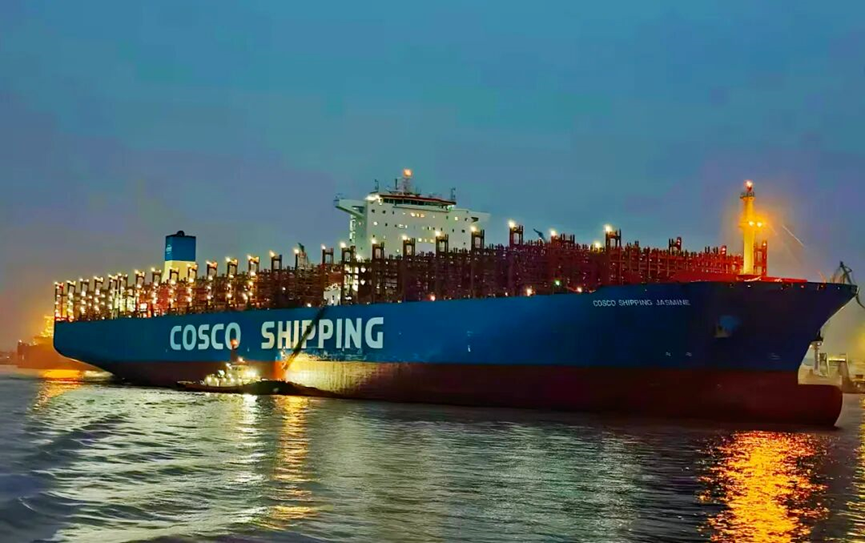
COSCO SHIPPING Jasmine
In February 2026, Tianjin COSCO SHIPPING and Guangdong COSCO SHIPPING Heavy Industry signed a construction contract for a 540 TEU coastal fully electric container vessel. This project is a pure electric container ship intended for coastal and port feeder transport scenarios. According to public information, the vessel has an overall length of 107.4 meters, a molded breadth of 21.2 meters, a tonnage of 9,200 tonnes, and a design speed of 9 knots. The propulsion system is fully electric, equipped with eight containerized battery power units with a total battery capacity nearing 16,000 kWh, sufficient for all-electric voyages without direct emissions during operation. The design incorporates a "charging and battery-swapping integrated" model, supporting both standard high-voltage shore power charging and battery swapping to accommodate energy replenishment under different port conditions. The vessel is scheduled for delivery in 2027 and will be deployed primarily on feeder barge services within the Yangpu Port area in Hainan. Subsequent operational plans include integration with onshore distributed green electricity resources through a "source-grid-load-storage-usage" model to coordinate power supply, storage, and consumption, advancing the practical application of fully electric vessels on commercial routes.
In January 2026, COSCO SHIPPING Holdings (601919.SH) disclosed that its wholly-owned subsidiary, COSCO SHIPPING Assets, had signed an agreement with Jiangnan Shipyard (Group) Co., Ltd. and China Shipbuilding Trading Co., Ltd. to order twelve 18,000 TEU LNG dual-fuel container vessels at a contract price of RMB 1.399 billion per vessel, totaling RMB 16.788 billion, with deliveries scheduled for 2028 to 2029.
Maersk
In December 2025, Maersk announced it would conduct a new round of ethanol fuel testing on its dual-fuel container vessel Laura Mærsk, marking a significant step in diversifying its low-emission fuel pathways. This trial will use a 50% ethanol and 50% methanol blend (E50), building on the successful initial E10 trial (10% ethanol / 90% e-methanol) completed between October and November, which confirmed ethanol can be safely and stably integrated into methanol fuel systems with good engine ignition, combustion, corrosion resistance, and lubricity, without compromising emission performance.
In February 2026, Maersk announced it had taken delivery of Tangier Mærsk, the first in a new series of medium-sized methanol dual-fuel container vessels. The vessel was named and delivered at Yangzijiang Shipbuilding's Jingjiang yard, signaling a new delivery cadence in Maersk's fleet renewal program. This follows Maersk's official announcement on June 26, 2023, to order six 9,000 TEU methanol dual-fuel container vessels from Yangzijiang Shipbuilding. All vessels in this batch are equipped with dual-fuel main engines capable of running on green methanol, with delivery windows spanning 2026 to 2027, the latest being March 2027.
In February 2026, Maersk announced the signing of a newbuilding agreement with China's New Times Shipbuilding Co., Ltd. for eight large container vessels. These newbuilds will form a new 18,600 TEU homogeneous series, scheduled for delivery in 2029 and 2030. With respect to propulsion and fuel strategy, this series will be equipped with dual-fuel engines capable of running on conventional fuel oil or LNG.
In March 2026, Avenir LNG disclosed that its wholly-owned subsidiary, Avenir Marine Limited, had entered into a framework fuel supply agreement with Maersk, signed in the second half of 2025. Under this agreement, Avenir will supply bio-LNG to Maersk starting from 2027. Maersk's website also confirmed this arrangement. In its energy transition plan, Maersk stated the company had signed a preliminary framework fuel supply agreement with UK-based Avenir Marine Limited in 2025 for the procurement of liquefied biomethane, or bio-LNG, with initial deliveries expected in 2027.
CMA CGM
On the morning of June 10, a production commencement meeting was held for the 182 TEU fully electric container vessel being built by Shandong New Energy Shipbuilding, a subsidiary of Jining Energy Group, for France's CMA CGM. The vessel has an overall length of 79.9 meters, a molded breadth of 15 meters, a design draft of 4.1 meters, and a deadweight of 3,500 tonnes. CATL provides the Battery Energy Storage System, with the hull carrying four 1,959 kWh swappable containerized batteries. The vessel is scheduled for deployment in 2026 on a green route from Binh Duong Province, Vietnam, to the Cai Mep port, with an annual transport volume exceeding 50,000 TEU.
In August 2025, Vanguard Renewables, a US-based renewable natural gas supplier, announced a commercial partnership with CMA CGM. Under the terms of the agreement, CMA CGM, through its energy fund PULSE, would make a strategic minority equity investment in Vanguard Renewables to secure long-term access to substantial volumes of RNG. Vanguard Renewables, headquartered in Weston, Massachusetts, specializes in producing biomethane from organic waste.
In January 2026, CMA CGM's 400th owned vessel, the methanol dual-fuel CMA CGM MONTE CRISTO, was named and delivered in Tianjin. Delivered by DSIC Tianjin, this vessel is the first methanol dual-fuel 15,000 TEU-class container ship built in North China and the first in a series of six methanol dual-fuel 15,000 TEU vessels for CMA CGM.
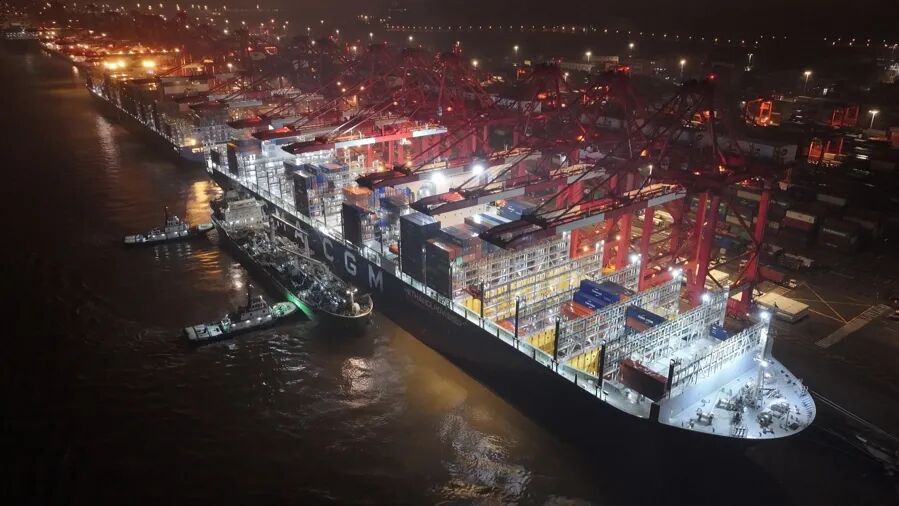
In March 2026, the methanol bunker vessel Hai Gang Zhi Yuan, operated by Shanghai International Port Energy, berthed alongside CMA CGM's newly delivered 13,000 TEU methanol dual-fuel container vessel CMA CGM OSMIUM in the Yangshan Port area, Shanghai, to commence green methanol bunkering operations. This operation, involving over 3,640 tonnes, set new records and marked CMA CGM's inaugural green methanol bunkering in Shanghai.
MSC
The series of LNG dual-fuel 16,000 TEU container vessels ordered by MSC at Yangzijiang Xinfu Shipbuilding achieved centralized deliveries in 2025, with the final vessel, MSC SAUDI ARABIA, setting sail on December 27, 2025. These vessels feature advanced fuel-saving technologies and Eco EGR to meet Tier III standards while reducing fuel consumption.
MSC ordered nearly 60 LNG dual-fuel container vessels in 2024, all placed at Chinese shipyards. In 2025, MSC added a further ~40 dual-fuel vessels. Giuseppe Gargiulo, head of MSC newbuilding, stated the company's fuel stance is pragmatic and incremental: "We are currently adding a large batch of LNG dual-fuel vessels, and in the future, over 150 ships will have dual-fuel capability. LNG is viewed as the transition fuel available today."
Hapag-Lloyd
In November 2025, Hapag-Lloyd signed provisional shipbuilding agreements with two Chinese yards for up to 24 methanol dual-fuel feeder container vessels with a total value of approximately $1.58 billion. The yards involved are CIMC Raffles and Taizhou Sanfu Shipbuilding.
Furthermore, Hapag-Lloyd's subsequent newbuilding program encompasses an additional 24 vessels, split between Yangzijiang Shipbuilding and New Times Shipbuilding, all LNG dual-fuel designs for delivery between 2027 and 2029.
In December 2025, ZEMBA announced Hapag-Lloyd as the winner of its second e-fuels tender, committing the carrier to deploy e-methanol produced from renewable hydrogen on a trade lane from 2027, offering ZEMBA members near-zero emission ocean transport services.
ONE
In February 2026, the 13,900 TEU ammonia/methanol-ready container vessel ONE SATISFACTION, owned by Ocean Network Express, was delivered by Imabari Shipbuilding. The vessel holds an AiP from Lloyd's Register for future conversion to methanol/ammonia fuel and carbon capture system installation.
Evergreen Marine
In March 2026, Evergreen's methanol dual-fuel vessel EVER ECHO successfully bunkered green methanol in Qingdao before its maiden voyage. The vessel is a 16,000 TEU-class methanol dual-fuel ship.
In November 2025, Evergreen completed its inaugural 3,000-tonne bio-methanol bunkering operation in Shanghai for its first of 24 16,000 TEU methanol dual-fuel containerships, delivered by Samsung Heavy Industries. Remaining vessels are scheduled for delivery through 2026-2027.
Hot News