





$2.25 Billion! Civil Settlement Reached in the "Dali" Bridge Collision Case
Source:CNSS
2026-05-20
There has been a significant recent development in the incident where the container ship "Dali" struck the Francis Scott Key Bridge. The government of Maryland, USA, has reached a civil settlement agreement with Grace Ocean, the shipowner of the vessel involved, and Synergy Marine, its operator, for a compensation amount of $2.25 billion.
The bridge is owned by the Maryland Transportation Authority (MDTA) and is expected to require several years for reconstruction. Maryland Attorney General Anthony Brown stated that this compensation reflects the "full liability" the state government could pursue from the shipowners. He simultaneously emphasized that the state will continue to advance its claims against the shipbuilder, HD Hyundai Heavy Industries, arguing that the shipyard's negligence was also a contributing factor to the collapse.
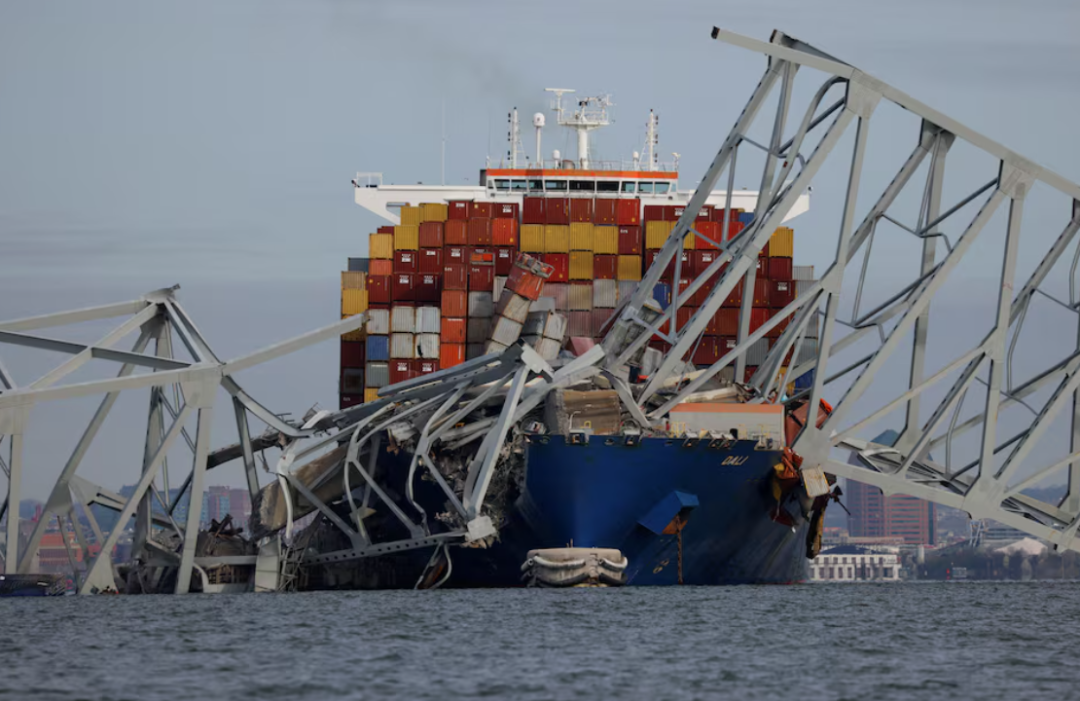
Delegate Johnny Olszewski pointed out that the settlement avoids the uncertainties and delays associated with a lengthy trial, allowing reconstruction funds for the bridge to be secured more quickly.
Previously, in April of this year, Maryland received a $350 million payout from ACE American Insurance Company based on an existing insurance policy. The rights to this payout were subsequently transferred to the shipowners.
Notably, Grace Ocean and Synergy Marine had previously invoked the Limitation of Liability Act of 1851, attempting to cap their liability at approximately $44 million, which represented the vessel's current value. While that legal proceeding is still ongoing, the $2.25 billion civil settlement far exceeds that proposed limit.
As the civil settlement progressed, the U.S. Department of Justice (DOJ) filed criminal charges last week against Synergy Marine and one of its Indian technical superintendents, Radhakrishnan Karthik Nair. The charges include conspiracy, intentionally failing to report known hazardous conditions to the Coast Guard in a timely manner, obstructing government proceedings, and making false statements. The indictment alleges that their actions resulted in the deaths of six workers and approximately $5 billion in economic losses.
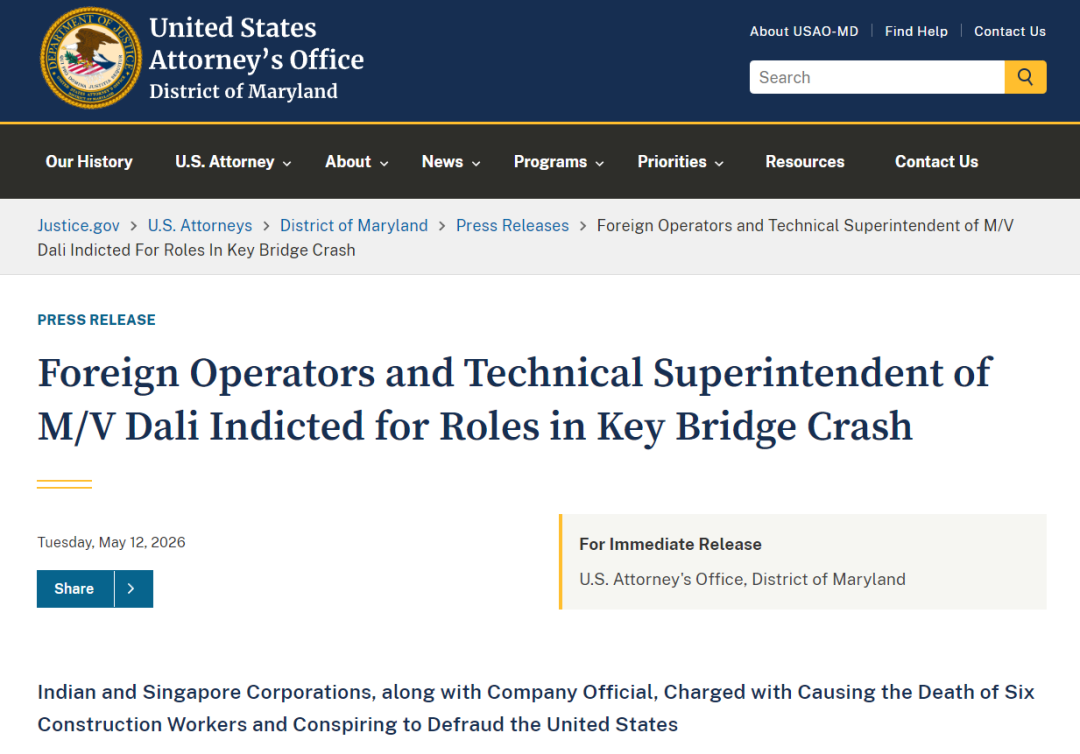
Reactions to the criminal charges have varied among the parties involved.
HD Hyundai Heavy Industries explicitly welcomed the charges, stating that they "correctly defined liability," which aligns with the findings of the National Transportation Safety Board (NTSB). The NTB had previously determined that a loose wire caused a power outage that ultimately led to the collision. Hyundai Heavy Industries firmly maintains that the power outage should have been detected through routine maintenance and was unrelated to the vessel's original design when it was delivered over a decade ago.
Meanwhile, Baltimore city officials expressed support for the criminal charges. They stated that the indictment asserts that "this tragedy was not an unavoidable accident, but rather the consequence of shocking corporate conduct." The city's legal counsel remarked that the federal charges "greatly corroborate the factual record established in the city's civil litigation".
In response to the criminal allegations, Synergy Marine countered that the DOJ is "criminalizing a tragic accident," calling the charges "baseless" and "completely unrelated" to the cause of the collision. The company emphasized that the issue regarding the use of a flushing pump mentioned by the DOJ is "entirely irrelevant to the cause of the impact" and contradicts the NTSB's conclusions. Synergy argued that the loose wire "cannot be attributed to the vessel's operations," pointing out that investigations revealed an improperly positioned label prevented the wire from being fully inserted into the interface. Based on this, the shipowner and management company claim there was a design defect in the switchboard. The company stated it will "vigorously defend itself," emphasizing that the vessel did not violate any operational regulations or the builder's recommendations, and maintained a "nearly perfect port state control inspection record" in the United States.
Furthermore, the cost of rebuilding the bridge continues to rise. According to commentary by maritime blogger Minorcan Mullet, replacement costs have escalated to between $8 billion and $9 billion.
It is also worth noting that the shipowner, Grace Ocean, previously argued that state government officials bore "significant responsibility and fault." They cited "decades of records" showing that the state failed to adequately protect the bridge, which was built in the 1970s with minimal pier protection. The NTSB report also indicated that had the Maryland Transportation Authority conducted vulnerability assessments as recommended in 1991 and 2009, the state should have recognized that the bridge was already at a risk threshold for catastrophic collapse. At the same time, the NTSB ruled out factors such as environmental conditions, waterway conditions, impairment of the crew or pilots, and fuel quality as influences on the collision.
Hot News