





Global Empty Container Ratio Soars to 33%—Far Exceeding Pre-Pandemic Levels
Source:CNSS
2026-06-02
According to the latest analysis from Sea-Intelligence, trade imbalances have pushed the proportion of empty container movements to record levels. Currently, one out of every three containers transported globally is empty, a marked deterioration compared to the pre-pandemic ratio of one in four.
Measured in TEU-miles, 30% of global container shipping operations now involve the repositioning of empty containers, up from 24% prior to the pandemic. Since the first quarter of 2019, the volume of empty container movements has surged by 65%, while laden container movements have grown by just 17% over the same period. Total demand, measured in TEU-miles, has increased by 40%.
Sea-Intelligence estimates that, in terms of distance transported, shipping lines now move twice as many empty containers as they did before the pandemic.
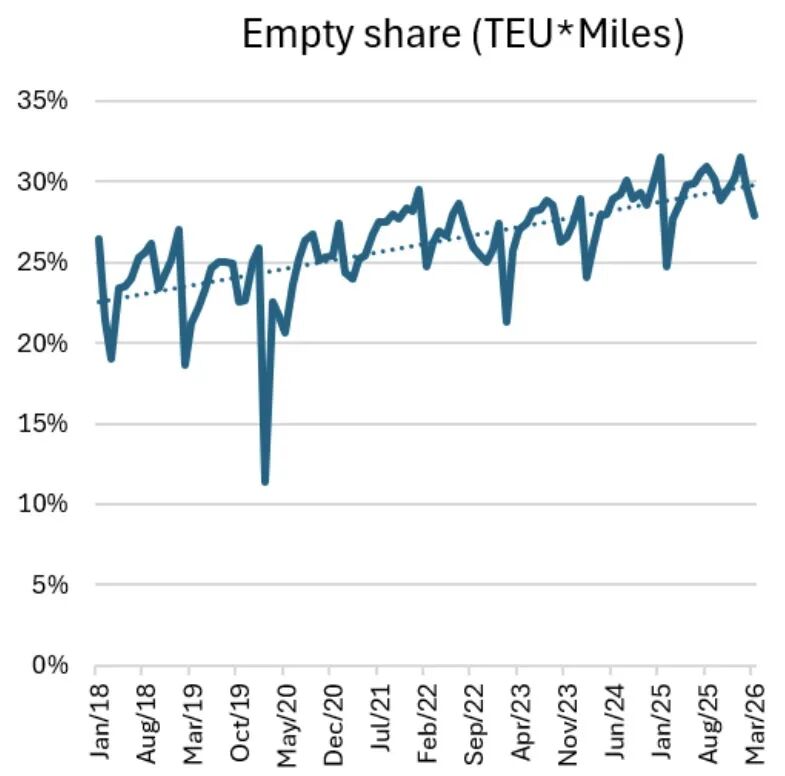
Source: Sea-Intelligence
The analysis points to worsening global trade imbalances as the direct driver of this trend. With cargo flows between regions becoming increasingly lopsided, shipping lines are forced to reposition empty containers to where they are needed, incurring costs and absorbing capacity in the process.
Sea-Intelligence warns that this trend has a direct impact on freight rates. "The additional costs generated by these imbalances will lead to higher costs—and consequently higher freight rates—ultimately borne by shippers on the heavy leg of the trade," the firm concluded.
The firm further noted that it is precisely those shippers on high-volume trade routes who end up shouldering the expense of managing the industry's growing surplus of empty container moves.
These findings underscore a deepening structural challenge facing the liner shipping industry: the efficiency gains achieved through ever-larger vessels and network optimization are increasingly being offset by the costs associated with managing global trade imbalances.
Hot News