





World Cup Fuels Explosive Surge in Container Freight Rates
Source:CNSS
2026-06-08
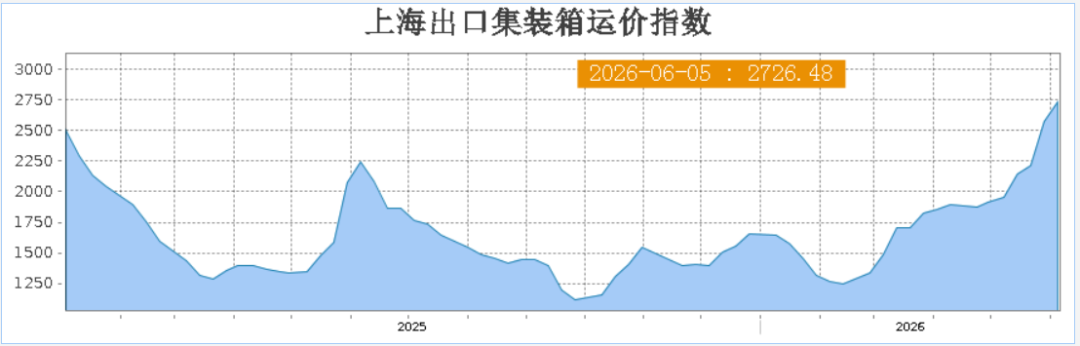
Driven by the ongoing Red Sea crisis, shippers rushing to move goods forward, and aggressive pricing by shipping lines, global container spot freight rates are soaring at a pace rarely seen in years. The Shanghai Containerized Freight Index (SCFI) has surged to a near two-year high, and the momentum of this early peak season appears to be intensifying further.
The SCFI, considered a barometer of the spot market, rose another 155 points this week to 2,726.48, not only marking a new cyclical high but also recording its fifth consecutive weekly gain. Meanwhile, the Drewry World Container Index (WCI) jumped 23% in a single week to $3,433 per 40-foot container (FEU) .
Almost all major routes originating from Asia saw across-the-board increases, with the Transpacific trade recording particularly staggering gains. Spot freight rates from Shanghai to Los Angeles surged 31% this week to $4,565 per FEU, while rates to New York rose 20% to $5,505 per FEU. The Asia-Europe trades were equally robust, with rates from Shanghai to Rotterdam and Genoa up 25% and 20% respectively, to $3,579 and $5,089 per FEU.
In its analysis, Drewry noted that the direct driver of this demand surge is the expectation of potential US tariff adjustments in July, prompting large numbers of shippers to significantly advance their shipment schedules. Additionally, cargo volumes are being simultaneously boosted by goods related to preparations for the 2026 FIFA World Cup in the US, Canada, and Mexico, alongside inventory restocking by major retail giants ahead of large-scale promotional events.
Shipping lines, currently enjoying the market upswing, have moved swiftly. Several liners have successfully imposed Peak Season Surcharges and sharply hiked Freight All Kinds (FAK) rates across various cargo types. Amid robust demand, the intent to manage capacity remains clear, with only three blank sailings scheduled on transpacific routes next week.
The ferocity of this rate surge has widely shocked the shipping analytics community. Lars Jensen, CEO of Vespucci Maritime and a veteran analyst, remarked bluntly on social media: "Spot rates are literally exploding this week." He noted that the balance of market supply and demand is heavily skewed in favor of sellers, and that the root cause of this early peak season remains the tensions in the Middle East.
Jensen believes the current Red Sea crisis actually stems from tensions in the Strait of Hormuz, and the resulting large-scale forced diversion of vessels around Africa continues to absorb significant amounts of effective capacity from the market. Notably, prior to this latest escalation, the industry had observed tentative signs of a gradual return of vessels to the Suez Canal—a prospect that has now evaporated.
The financial sector has also expressed further optimism regarding the short-term outlook for shipping. HSBC Global Research explicitly noted in a recent report that the container shipping market has entered an early peak season, and this momentum appears set to continue in the coming months. The report identified shippers' early stocking, port congestion, and carriers' capacity management strategies as the three core factors contributing to the tightening of effective supply.
The impact of preparations for the 2026 FIFA World Cup is far more profound than it appears on the surface. In terms of timing, World Cup-related cargo demand has created a rare triple overlap with tariff-driven panic shipping and the traditional Christmas stocking season. Orders for infrastructure materials, electronic security equipment, and large screens needed for stadium construction are being delivered intensively from factories in Asia. As many World Cup-related goods are precisely those targeted by potential tariff hikes, routine event procurement has evolved into panic-driven rush shipments. This is compounded by retailers' inventory restocking for World Cup-themed promotions, which is almost seamlessly overlapping with back-to-school and Christmas season procurement cycles, continuously driving up cargo volumes.
Geographically, the host nations—the United States, Mexico, and Canada—are all located on Transpacific trade lanes. This explains why freight rate increases on routes from Shanghai to Los Angeles and New York have been particularly ferocious—additional demand has directly hit an already strained capacity pool. More subtly, a supply chain "butterfly effect" is at play: stadium construction has pulled in demand for raw materials like steel and aluminum exported from Asia. To fulfill orders, Asian factories have increased imports of precision machinery from Europe, boosting volumes on Asia-Europe routes. Meanwhile, shipping lines are reallocating capacity toward the more lucrative Transpacific trade, tightening capacity on routes to South America and Africa and creating a global scramble for vessels.
In short, the World Cup has created a rigid demand foundation that has amplified the capacity shortfall caused by the Red Sea crisis and tariff fears. These three forces have combined, ultimately detonating this rate surge that has stunned the market.
Hot News