





"Qingdao Port-Rizhao Port-Central Asia" Cross-Border Logistics Corridor Opens
Source:China Shipping Gazette
2026-06-12
Through the continuous optimisation of the sea-rail intermodal system, the cross-border transport capacity of the Central Asia freight train service has been effectively enhanced.
Recently, an international rail-sea intermodal transit train fully loaded with 110 TEU of containers departed from Rizhao Port of Shandong Port Group and successfully arrived in Kazakhstan via the Alashankou land port. This marks the successful establishment by Shandong Port Logistics Group of a new "Qingdao Port–Rizhao Port–Central Asia" cross-border logistics corridor, adding another achievement in support of the Belt and Road Initiative.
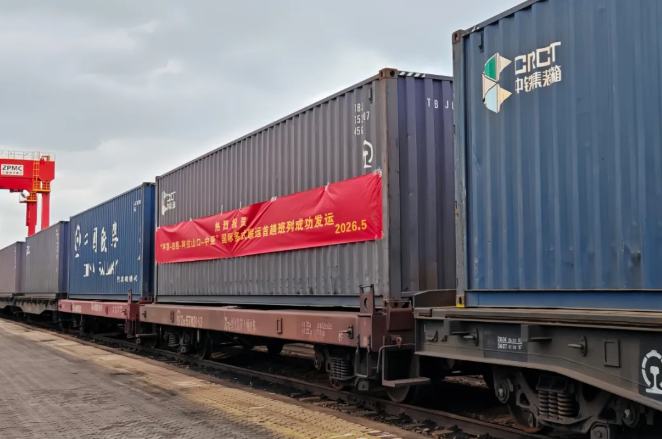
To launch this train service, Shandong Port Logistics Group worked closely with customs, railway authorities, and the port to drive deep integration between international trunk shipping lines, feeder services, and rail dispatch. By continuously optimising the sea-rail intermodal system, the Group effectively enhanced the cross-border transport capacity of the Central Asia freight train service, pushing Central Asia cross-border logistics into a new phase of efficient connectivity and stable operations.
During the organisational process, the company's business teams implemented precise control over key nodes across the entire chain, closely monitoring aspects such as feeder vessel arrivals at the port, container transhipment, and rail marshalling. Personnel and equipment resources were coordinated in advance, dedicated operational areas were designated, and a specialised operational plan was formulated. At the same time, the Group strengthened coordination with Qingdao Port and the Central Asia freight train forwarding agents to efficiently complete procedures including inspection, container stuffing, re-inspection, and data submission, achieving seamless container transfer from port to railway and ensuring the train's timely departure.
Shandong Port Logistics Group stated that it will use this as an opportunity to continue deepening its presence in the cross-border logistics market, continuously optimise its production organisation model, strengthen multi-party coordination, and ensure the regular and efficient operation of the Central Asia freight train service.
Hot News