





New Port Regulations to Take Effect Soon! Five Vessel Categories Will Trigger On-Site Inspections
Source:CNSS
2026-04-20
Vessels recently calling at Port Hedland are aware that the port will officially implement new regulations governing vessel vetting and pre-berthing inspections effective May 1 of this year.
In practice, the implementation of these new regulations will have minimal impact on vessels regularly trading on fixed routes to Port Hedland. As long as the Port Hedland Vessel Vetting Form and the Port Hedland Pre-Berthing Checklist are submitted within the prescribed cycle or timeframe, an on-site audit inspection will not be conducted. However, the new regulations explicitly stipulate that the following categories of vessels will trigger an on-site inspection mechanism.

Trigger Criteria
1.First-time or Infrequent Callers: Vessels that have not called at Port Hedland within the preceding 24 months.
2.Recent Machinery Failure at Another Port: Vessels that have experienced a failure of the main engine, auxiliary engine, or steering gear at another port or at sea within three months prior to arrival at Port Hedland.
3.Machinery Failure During Previous Port Hedland Call: Vessels that experienced a failure of the main engine, auxiliary engine, emergency generator, or steering gear during their last call at Port Hedland.
4.Port State Control (PSC) Detention: Vessels detained under PSC due to crew inability to operate machinery, failure of the Safety Management System, machinery breakdown, or any condition affecting the vessel's seaworthiness.
5.Harbour Master's Risk-Based Determination: Vessels identified by the Harbour Master's Marine Team as requiring inspection based on operational risk, vessel condition, past performance history, poor performance record of the technical manager, or recurring failures across multiple vessels under the same management.
Inspection Location and Timing
1.Up to 30 days prior to arrival.
2.Upon arrival, within the discharge port anchorage or the Port Hedland anchorage.
The official notice further clarifies that machinery inspections conducted pursuant to this notice must be confined exclusively to the anchorage area.
The so-called compliance or vetting inspection, as the name implies, constitutes an on-site verification of the information submitted by the vessel in the Vessel Vetting Form to confirm its accuracy against actual conditions. This inspection is performed by a third-party entity engaged by the port authority. Typically, the port authority will advise the vessel, through its agent, in advance regarding the timing and location of the inspection. During my vessel's recent call at Port Hedland to load Australian salt, an inspection was triggered under the new regulations as this was the vessel's first call to the port. Consequently, I had the opportunity to experience one of the port's on-site compliance audits prior to the formal effective date of the new rules. Although the regulations stipulate that such inspections should be conducted at the anchorage, my vessel underwent the inspection after berthing, as the new regulations had not yet formally entered into force. This felt somewhat akin to a pre-event warm-up session organized by the host before a major sporting competition.
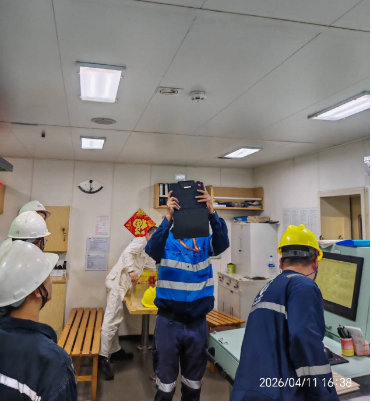
My vessel berthed at 1412 LT on April 11. At 1430 LT, an elderly gentleman of Indian origin boarded and introduced himself as a representative of MERS SOLUTIONS, engaged by the Pilbara Ports Authority (Port Hedland falls under the Pilbara Ports Authority) to conduct the compliance on-site audit inspection. Below, we shall follow the inspector's process and share the inspection experience with fellow mariners.
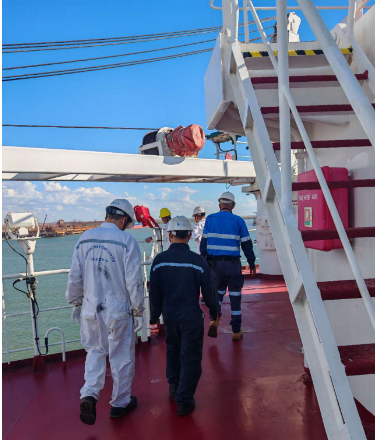
Following brief introductory courtesies, the inspection formally commenced. The inspector provided a concise overview of the process: document review – navigation bridge inspection – external deck walk (accommodation block levels) – main deck inspection – engine room inspection. All inspections encountered onboard generally follow a similar pattern: documentation first, followed by the on-site component. This particular audit inspection differed from others in that the entire walkthrough was strictly confined to verifying items listed in the vetting form.
1.Document Review: Given the defined scope, the document review was relatively limited, encompassing items such as the submitted Vessel Vetting Form, mooring rope maintenance records, brake test records, main and auxiliary engine performance parameters, fuel and lubricating oil analysis reports, Bunker Delivery Notes, NOx Technical File records, and the Engine Room Planned Maintenance System records.
2.Navigation Bridge Inspection: The bridge inspection was limited to the follow-up and non-follow-up steering gear systems, involving a 10-degree helm movement to port and starboard respectively to verify steering system response.
3.Engine Room Ventilation and Dampers: Inspection of engine room fans, fire dampers, and funnel louvers included functional open/close testing and verification of sealing integrity.
4.Emergency Generator Inspection: Testing included the fuel oil quick-closing valve, spring starter accumulator activation, bus tie breaker functionality between the main switchboard and emergency switchboard, and a full blackout simulation to confirm automatic emergency generator start and load acceptance.
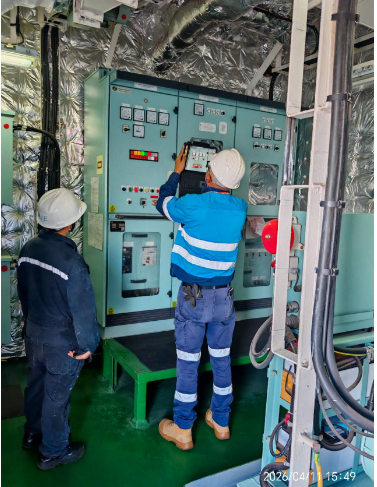
5.Emergency Fire Pump Inspection: Two fire hoses were deployed at the stern, and the emergency fire pump was started to verify adequate water pressure at both hose outlets.
6.Main Deck Walk: Visual inspection of cargo hold cleat securing arrangements and the condition of hatch cover rubber packing seals.
Hold and Emergency Bilge Pump Inspection: Verification of whether routine operational testing of the emergency bilge suction valve for cargo holds had been conducted.
7.Bosun Store Inspection (Forepeak): Condition assessment of the Bosun Store, with a reminder issued regarding the requirement to properly secure manhole cover securing bolts for the chain locker access.
8.Forecastle Deck: Verification of operating instructions posted for mooring winches and windlass, confirmation of the marked date of the most recent brake test, and assessment of mooring line condition.
9.Return to Accommodation Block – Fire Control Station: Inspection of the main fire line isolating valve for freedom of movement, and a query directed to the Fourth Engineer regarding the operational scenarios warranting use of the isolation valve.
10.Engine Room Entry: General observational assessment of overall engine room cleanliness and condition.
11.Boiler Inspection: Testing of high and low water level alarm functionality.
12.Steering Gear Compartment Inspection: Testing of communication systems between the steering gear compartment and the navigation bridge; verification of emergency steering changeover procedures and functionality; comprehensive alarm testing.
13.Engine Room Water Mist System Inspection: Review of water mist system testing records.
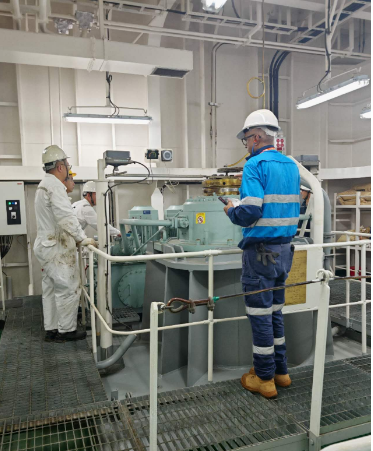
14.Auxiliary Engine Inspection: Removal of a cover from one auxiliary engine to visually inspect for fuel or lubricating oil leaks; testing of fuel oil leak detection alarms; remote start and synchronization testing of standby generators.
15.Air Compressor Inspection: Alternating start-up of both air compressors to verify pressure build-up functionality.
16.Sewage Treatment Plant Inspection: Testing of the high-level alarm.
17.Main Engine Lubricating Oil System Inspection.
18.Fuel Oil Purifier Room Inspection: Inquiry regarding the procedure for adjusting oil temperature.
19.Main Engine Inspection: Testing of the main engine crankcase oil mist detection system; review of the Main Operating Panel functionality, including locating the manual function test pages for exhaust valves and fuel injectors; inspection of tacho sensor status; review of main engine alarm history; and inquiry regarding backup arrangements for the engine control operating system.
20.Oily Water Separator Inspection: Simulated 15 ppm alarm test with operational start-up. The inspector emphasized the requirement that the simulation must accurately replicate an alarm condition triggered precisely as the 15 ppm threshold is reached, rather than an overshoot alarm occurring when transferring between tanks.
21.Engine Room Bilge Well High-Level Alarm Testing.
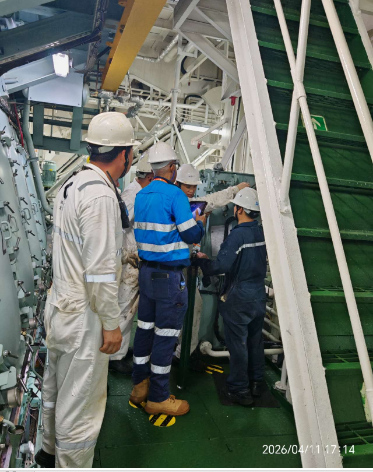
22.Engine Control Room Inspection: Review of documented procedures for emergency response to a full blackout; verification of insulation resistance monitoring; review of the list of critical equipment; verification of main engine operating program software and safety system status; fire detection loop sensor testing accompanied by a query to the Fourth Engineer regarding the appropriate response to a fire alarm activation.
23.Upon conclusion of the Engine Control Room inspection, the on-site audit was completed. I escorted the inspector to the mess room for a meal. The gentleman shared that he had resided in Hong Kong for an extended period, understood a little Cantonese, and humorously considered himself half-Hongkongese. He relocated to Australia three years ago and now resides in Perth. He maintains a relatively consistent inspection schedule, averaging one to two vessels per day. Vessels subsequently requiring this type of inspection are likely to be attended by him.
Summary: The Port Hedland Vessel Compliance Audit Inspection is conducted by a third-party entity engaged by the port authority. The inspection primarily focuses on verifying the operational readiness of the vessel's machinery, equipment, and mooring systems. The third-party inspector will issue a Compliance Observation Report based on the findings. Unlike a legally binding Port State Control report, this Observation Report constitutes a commercial assessment and carries no direct legal enforcement authority; nevertheless, it holds significant referential weight. The overall atmosphere of this inspection tends to be relatively measured. As the outcome is an observational report, isolated minor deficiencies are generally not recorded, provided the overall condition of the vessel is deemed satisfactory. Vessels trading to Australia routinely undertake meticulous preparations prior to arrival. Consequently, achieving a favorable outcome—and securing a deficiency-free Observation Report—is a readily attainable objective for this type of inspection.
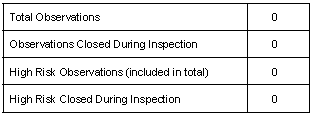
Finally, I extend my best wishes to all fellow mariners for safe voyages and the attainment of favorable results, including deficiency-free reports, in all inspections encountered.
Hot News