





World's Largest Subsea Rock Installation Vessel Set to Arrive
Source:Guangzhou Port Authority
2026-04-13
The world's largest subsea rock installation vessel, Windpiper, recently arrived in Rotterdam for final outfitting and commissioning and will proceed to the Baltic Sea in the second half of this year to undertake its first offshore assignment.
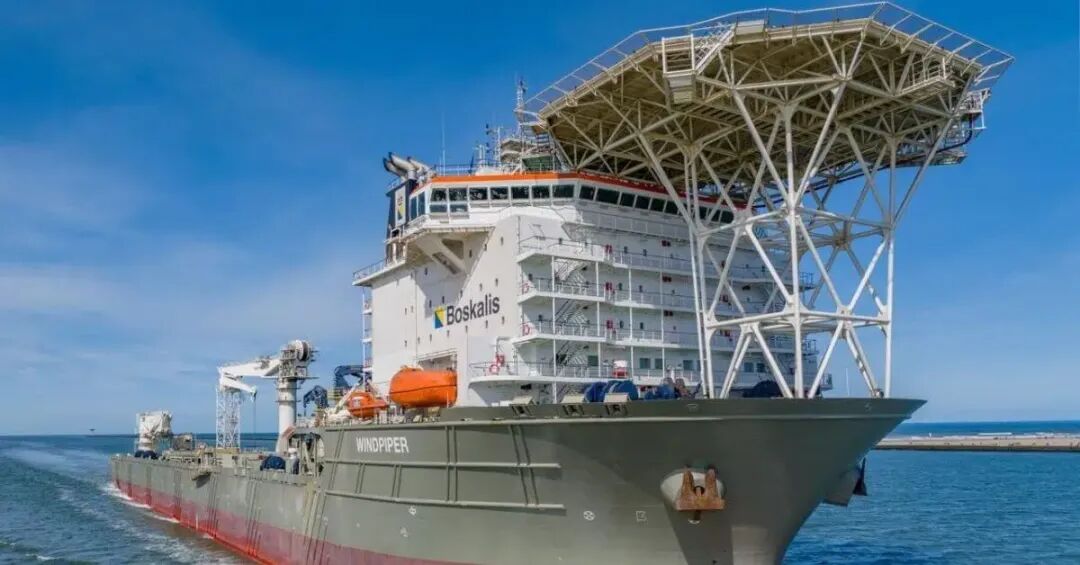
The vessel arrived at the port in early April 2026 and is currently moored in the Waalhaven, where it will undergo final upgrade work. Thereafter, it is expected to commence its inaugural rock installation operations in the Baltic Sea.
Windpiper was developed by Boskalis and boasts a rock carrying capacity of 45,500 tonnes, the largest of any vessel of its type globally. The vessel has an overall length of 227 meters, a beam of 40 meters, and a total installed power exceeding 31,000 kW.
Boskalis first announced the project in January 2025. At that time, the vessel served an entirely different purpose and underwent an extensive conversion to be transformed into a subsea rock installation vessel. The conversion involved the addition of two large rock holds and the installation of an inclined fall pipe system. Operating in conjunction with the vessel's moonpool, this system enables the high-precision placement of rock onto and around offshore structures, which is critical for protecting infrastructure such as offshore wind foundations.
The vessel is equipped with seven thrusters and is certified to DP2 dynamic positioning standards, enabling it to automatically maintain position even in the event of a single component failure. Boskalis stated that the vessel is specifically designed for harsh sea conditions and will significantly strengthen its position in this specialist market, where Boskalis currently operates three similar vessels.
Windpiper's total carrying capacity is distributed across two separate rock holds. This configuration makes it particularly well-suited for projects involving long distances between the load port and the offshore worksite.
Such long-haul operational conditions are common in regions including the Baltic Sea, the North and South Seas, and the East Coast of North America. Greater onboard capacity translates into fewer round trips, thereby contributing to lower overall project emissions and costs.
Additionally, the vessel features over 100 single cabins, providing private accommodation for crew members and client representatives.
Boskalis noted that compared to newbuilding, converting an existing vessel not only enables a faster entry into service but also contributes to extending the vessel's operational lifespan.
Hot News