





A private shipbuilding newcomer is sprinting towards an H-share listing
Source:CNSS
2026-06-02
On June 1, Dajin Heavy Industry, a leading offshore wind power equipment manufacturer, announced that the company and its subsidiary, Tangshan Dajin Offshore Engineering, have each signed two bulk carrier construction contracts with a Greek shipowner and a Norwegian shipowner. The contracts cover the design, construction, and delivery of a total of four 211,000 DWT bulk carriers. Each vessel will have an overall length of approximately 299.95 meters, a molded breadth of around 50 meters, and a molded depth of about 25 meters.
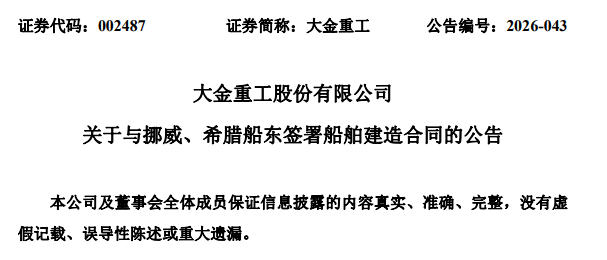
The total value of the construction contracts for these four vessels is approximately $300 million. Delivery of these ship orders is scheduled in batches by 2029.
According to the announcement, the Norwegian shipowner focuses on the operation of its own fleet, newbuilding investments, secondhand ship trading, long-term charters, and offshore project deployment. The Greek shipowner is a professional tanker owner and ship management company primarily engaged in crude and product tanker transportation, vessel operations, and asset management.
Dajin Heavy Industry stated that the signing of these contracts marks a broad recognition of the company's shipbuilding capabilities by leading international shipowners and is expected to have a positive impact on future operating performance.
Since April 23, 2026, including the latest deal, Dajin has secured 14 external shipbuilding orders:
Contracts with Seatankers Management and Danaos Corp for four 210,000 DWT bulk carriers each, totaling approximately $591 million.
A contract with a subsidiary of Jumbo for two 25,000 DWT green, intelligent multipurpose heavy-lift vessels, with a total contract value of about $156 million.
A contract with Cape Shipping for two 211,000 DWT bulk carriers, with a total contract value of roughly $153 million.
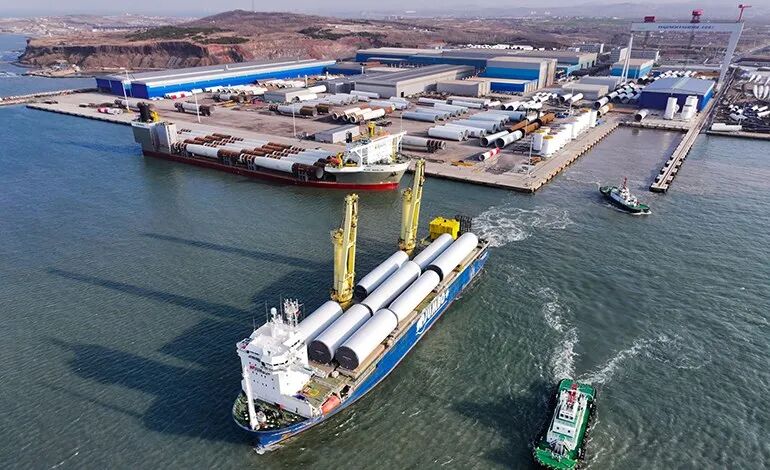
Dajin has clearly defined the strategic positioning of its shipbuilding business as leveraging its independent shipbuilding capabilities to empower the self-reliance and controllability of the global wind power industry chain, rather than simply undertaking ship orders. This strategy aims to achieve three key objectives: industrial chain security, in-depth customer service, and steady growth in its shipbuilding business. Going forward, the company's self-built fleet will focus on supporting the submersion, transportation, and on-site operations of floating wind turbine foundations in the European region. This will not only enhance the stability and efficiency of the company's global deliveries but also integrate one-stop engineering services for customers, while ensuring the sustainable operation of the shipbuilding segment to build a collaborative development ecosystem where all parties achieve win-win outcomes.
Concurrently, Dajin Heavy Industry is preparing for an H-share listing. In a May 28 announcement, the company stated it is proceeding with an application to issue overseas-listed foreign shares (H-shares) and list on the Main Board of the Hong Kong Stock Exchange. The maximum offer price for this H-share issuance is HK$66.40 per share. The public offering commenced on May 28 and is expected to close on June 2, with the offer price expected to be announced on or before June 3. The H-shares are expected to be listed and commence trading on the Hong Kong Stock Exchange on June 5, 2026.
As a core supplier of offshore wind power equipment, Dajin Heavy Industry has continuously expanded the boundaries of its industry chain in recent years. It has formed a diversified business matrix encompassing the R&D and manufacturing of offshore wind power equipment, specialized ocean-going transportation, vessel design and construction, new energy development and operation, and wind power home port operations. The company has firmly established itself among the pioneering ranks of the global wind power equipment manufacturing industry. With its autonomous control over the "transportation + installation" stages serving as a pivot, the company is accelerating its transformation from a pure product supplier to a system service provider.
Currently, Dajin has built a shipbuilding base in Panjin, equipped with the capability for customized vessel research and development. In October 2025, the first 40,000-tonne deck transport vessel successfully launched at this base, commencing its maiden voyage in February 2026.
Regarding the order-taking strategy for the Panjin shipbuilding base, Dajin Heavy Industry stated it will balance the construction of its own vessels with external order demand, prioritizing orders related to the wind power sector and, where surplus capacity exists, moderately undertaking other vessel types with favorable commercial terms.
In 2025, Dajin Heavy Industry achieved revenue of RMB 6.174 billion, a year-on-year increase of 63.3% , and net profit of RMB 1.103 billion, up 132.9% year-on-year. The net profit margin rose from 9.8% in 2023 to 17.9% in 2025. The main driver was the optimization of its business structure, with the proportion of overseas revenue increasing from 39.6% to 74.5%. The gross profit margin of its overseas operations reached 33.9%, nearly 1.5 times that of its domestic business.
Hot News