





Seaspan's First Methanol Dual-Fuel EPC Conversion Project Completed
Source:CNSS
2026-06-03
On June 2, the first vessel in the Seaspan 10K series methanol dual-fuel conversion project, the Seaspan Yangtze, completed all retrofit work ahead of schedule at COSCO SHIPPING Heavy Industry (Shanghai) and was successfully delivered into operation. This is the first of five conventionally powered containerships that Seaspan plans to convert.
The Yangtze is currently operated by Hapag-Lloyd under a long-term charter and has been formally handed back to the owner after nearly three months of conversion work.
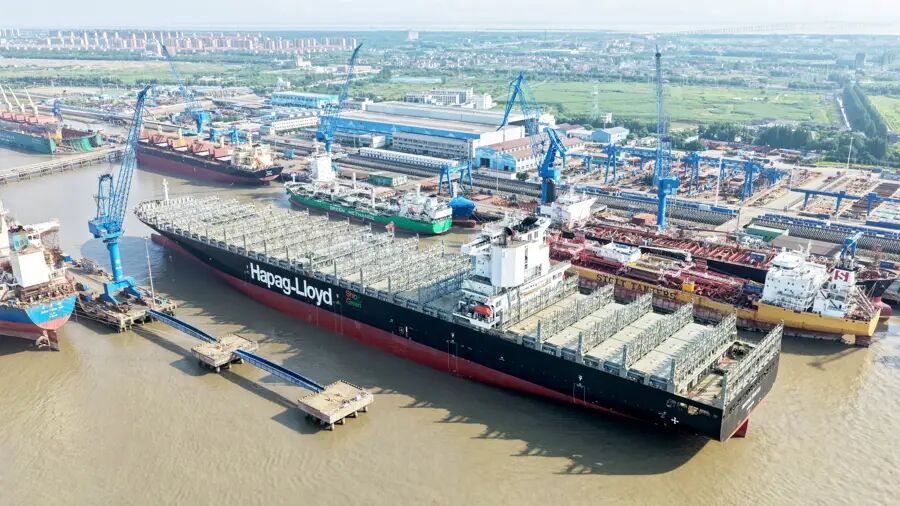
This marks another industry benchmark for COSCO SHIPPING Heavy Industry (Shanghai), following its delivery of the world's first methanol dual-fuel main and auxiliary engine conversion project. It is also Seaspan's first methanol dual-fuel EPC (Engineering, Procurement, Construction) turnkey project, signifying a pivotal leap for the shipyard in the green vessel conversion sector, transitioning from serving domestic clients to engaging with top-tier international shipowners.
Built in China in 2014 and previously operated by Hanjin Shipping, the 337-metre-long Yangtze has a deadweight of 115,318 tonnes and was originally equipped with a conventionally fuelled MAN S90 engine.
In 2024, Seaspan and Hapag-Lloyd announced plans to convert five 10,100 TEU containerships, starting in the first quarter of 2026. The two companies stated the project would involve an investment of approximately US$120 million and encompass five Seaspan-owned vessels—Seaspan Amazon, Seaspan Ganges, Seaspan Thames, Seaspan Yangtze, and Seaspan Zamberzi.
According to Hapag-Lloyd's sailing schedule, the Yangtze will set sail from Ningbo on June 10. It will call at several ports in China before heading to New York and Norfolk.
From contract signing to delivery, the project took only 18 months, with the vessel able to operate normally during a 15-month period for major equipment procurement. The yard conversion itself took less than three months. Compared with the five-to-six-year cycle for a newbuild large dual-fuel containership, COSCO SHIPPING Heavy Industry (Shanghai)'s conversion model offers clear efficiency advantages.
According to the project manager, a key technical challenge involved converting a cargo hold into a methanol storage tank with a capacity of 9,098.8 cubic metres, while simultaneously upgrading the original main engine components to transform the conventionally fuelled engine into one capable of running on both conventional fuel and methanol. The entire methanol dual-fuel conversion, from vessel arrival to departure including sea trials and delivery, was completed in just three months.
COSCO SHIPPING Heavy Industry (Shanghai) highlighted that the massive engineering scope included the conversion of the main engine and auxiliary engines, along with the integration of fuel systems and piping. Furthermore, the engineering team needed to install the methanol fuel tanks and seized the opportunity to upgrade the engine room command and control systems to enhance the vessel's operational efficiency.
The shipyard reported that using methanol as a clean marine fuel reduced the Yangtze's post-conversion EEXI rating by approximately 55% compared with Phase 0 requirements. However, to accommodate the dedicated methanol fuel tank, the vessel sacrificed roughly 1.5% to 2% of its container carrying capacity.
This is the third conversion project and fifth vessel undertaken by COSCO SHIPPING Heavy Industry. Previously, the group completed its first project in 2025 involving the COSCO Leo and its sister vessel COSCO Gemini (20,000 TEU), and its second project in 2026, converting the COSCO Peony and COSCO Jasmine (13,300 TEU).
According to DNV's Alternative Fuel Insights database, just over 100 methanol-capable vessels are currently in operation, with containerships accounting for the largest share. Although the overall pace of methanol-fueled vessel adoption has slowed somewhat, the database shows that over 200 methanol-capable ships remain on order, with deliveries expected by 2030.
Hot News