






First Pinglu Canal Smart Demonstration Vessel Completes Sea Trials
Source:CNSS
2026-06-22
On June 17, Beigang Yunhe 002, the first demonstration vessel developed, designed, and built under the coordination of Beibu Gulf Port Group for the Pinglu Canal's Class A equivalent navigation zone, successfully completed its full programme of sea trials in Guigang. This marks the official transition of Pinglu Canal smart vessels from the construction phase toward operational deployment. The vessel will enter trials on the Pinglu Canal once the waterway meets the conditions for navigation.
Beigang Yunhe 002, which has now completed its trials, is a 5,000-tonne green smart demonstration cargo vessel designed for the Pinglu Canal's Class A equivalent navigation zone. It is a key component among the two vessel types and four demonstration ships planned for the canal. Positioned as an inland river cargo vessel for the Xi River trunk line–Pinglu Canal–Qinzhou Bay river-sea interface waters, it is specifically adapted to the unique navigational conditions of the Qinzhou Bay river-sea interface zone. The trials lasted approximately six hours and primarily tested smooth main engine operation, steering, navigational performance, and course-keeping stability.
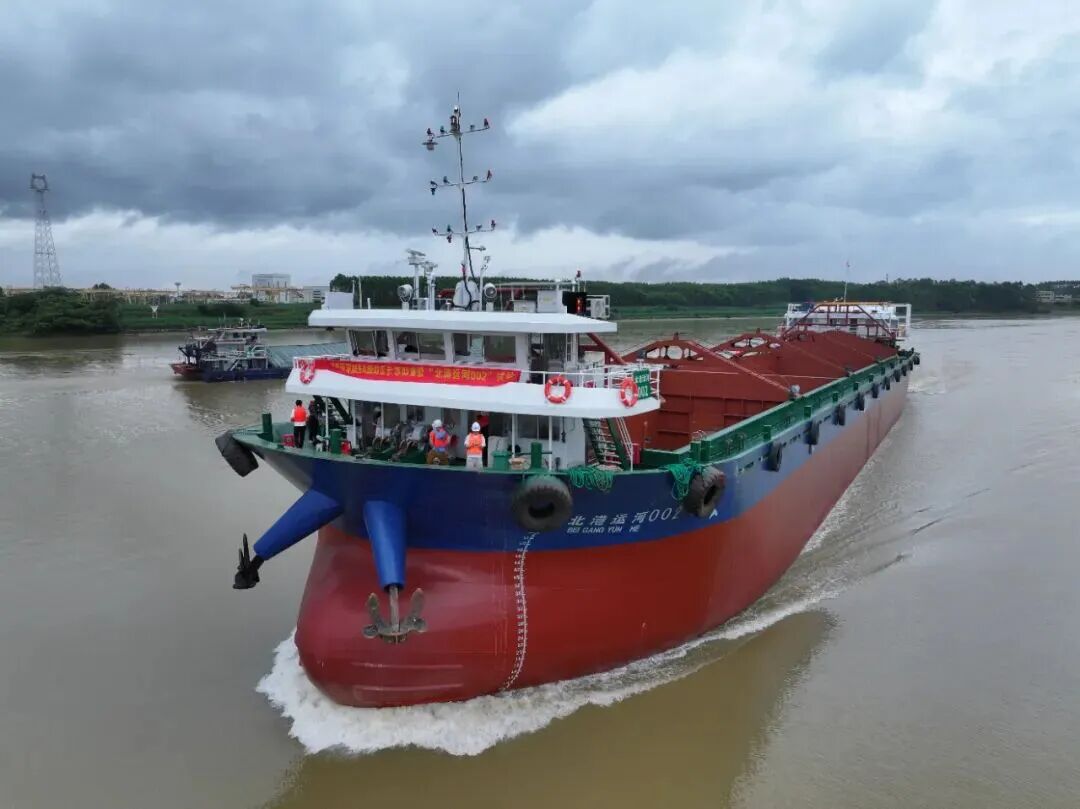
The vessel is powered solely by pure LNG clean energy. With an overall length of 89.92 metres, a beam of 15.75 metres, and a moulded depth of 6.05 metres, it is strictly designed to meet Pinglu Canal navigation standards. Compared with conventional diesel-powered vessels, it can achieve an annual carbon reduction of 23%, a 99% reduction in sulphur oxide emissions, and a 92% reduction in nitrogen oxide emissions. Pollutant emissions are drastically reduced, approaching near-zero levels, providing a replicable and scalable demonstration model for the green, smart upgrade of inland waterway vessels.
According to CCTV News, the effective dimensions of the Pinglu Canal locks are 300 metres in length, 34 metres in width, and 8 metres in depth, allowing up to six vessels of this size to pass through at once. Compared with river-sea intermodal vessels, the Beigang Yunhe 002 has a smaller tonnage and is not designed for open-sea navigation; however, it can operate in the waters of the Qinzhou Bay river-sea interface zone designated as a Class A equivalent navigation area.
The smart vessel demonstrated in these trials integrates a range of intelligent systems. An Integrated Smart Platform serves as the ship's "central brain," aggregating core navigational data and enabling ship-to-shore communication and data transmission. Meanwhile, a Smart Navigation System fuses data from multiple sensors with real-time waterway perception capabilities, providing obstacle warning and intelligent route planning functionality.
Currently, the first batch comprises four smart vessels. In addition to the Beigang Yunhe 002, which has just completed its trials, the remaining three have also been structurally joined. Of these, Beigang Yunhe 001 and Beigang Yunhe 002 are pure inland river vessels; the other two are river-sea intermodal ships. They will successively undergo their own sea trials and are scheduled for delivery in August 2026, when they will enter service on the Pinglu Canal's river-sea direct routes.
Hot News